Thursday, February 10, 2022

WPA music in Los Angeles


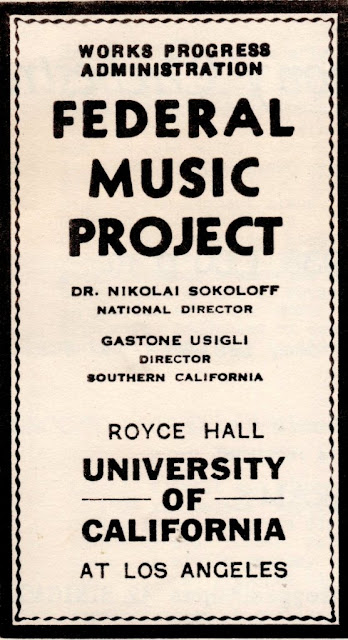
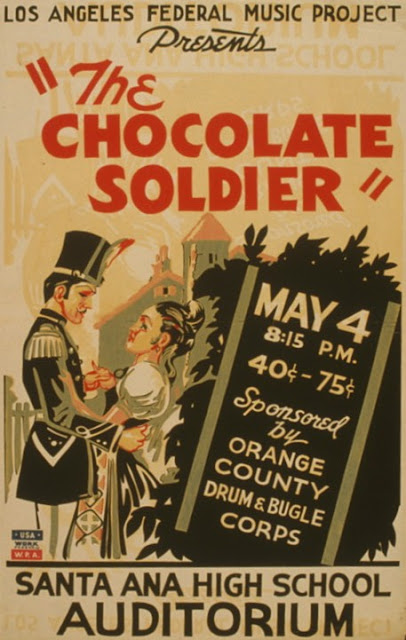
Above: A WPA poster, promoting an upcoming production of the Los Angeles Federal Music Project. The Chocolate Soldier is an operetta set in the late-1800s, Bulgaria. Image courtesy of the Library of Congress.

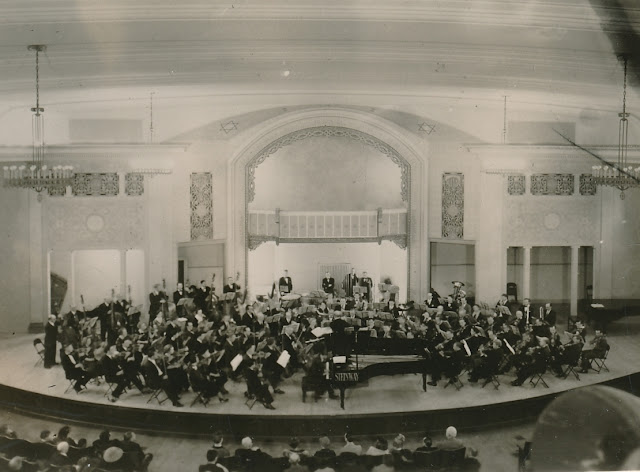
Above: The description for this photograph reads: "WPA Symphony Orchestra of Los Angeles - Orchestra No. 2, Federal Symphony Orchestra, Sunday Afternoon,  - Jan. 5, 1936." Photo courtesy of the National Archives.


Above: The description for this photograph reads: "Thirty-five thousand persons hear Los Angeles WPA Symphony and Choral Units at Easter Sunrise Service in Hollywood Bowl, 1937." Photo courtesy of the National Archives.


Above: A close-up of a section from the previous photo.


Above: Part of a newspaper story from The Pomona Progress Bulletin (Pomona, California), May 28, 1941, p. 16, noting a popular performance of the Los Angeles WPA Symphony Orchestra. Image from newspapers.com, used here for educational and non-commercial purposes.


Above: The front of a music program, for a December 8, 1938 performance of the WPA's Los Angeles Symphony Orchestra. Image scanned from personal copy.


Above: The contents of the program. Image scanned from personal copy.


Above: The back of the program, highlighting other WPA shows. Image scanned from personal copy.


Above: Listen to a 1930s performance of the WPA's Symphony Orchestra of Los Angeles. At about the 7:57 mark, the host talks about the WPA nursing program and how it helped curb the spread of contagious disease. Think about how this relates to our current covid pandemic. The original broadcaster of this radio program is unknown, but it is used here for educational and non-commercial purposes.

Above: A WPA African American chorus in Los Angeles, ca. 1935-1943. The "WPA Negro Chorus" is mentioned numerous times in archived Los Angeles County newspapers, and they appear to have been enormously talented and popular. For example, on April 18, 1941, it was reported that "This singing group has been acclaimed in performances all over Southern California. It drew a packed house in a recent performance at George Pepperdine College" ("Playground Holds Community Night: WPA Chorus Will Sing At Exposition Center," The Los Angeles Southwest Wave, p. 1). And on January 24, 1942, it was noted that 1,000 people at San Pedro High School enthusiastically responded to "the excellent musical program provided by the Los Angeles WPA Negro chorus... The beautifully blended voices were expertly directed by Mr. [Gilbert] Allen..." ("Auditorium Filled to Near Capacity for Friday Club Program," News-Pilot, p. 5). Photo above courtesy of the National Archives.


Above: An advertisement in the Daily News (Los Angeles, California), September 23, 1941, p. 18, announcing the "WPA Negro Chorus," directed by Gilbert Allen. Image from newspapers.com, used here for educational and non-commercial purposes.


Above: Gilbert Allen, one of the directors of the WPA Negro Chorus in Los Angeles. From the San Pedro News-Pilot (San Pedro, California), November 15, 1941, p. 8. Image from newspapers.com, used here for educational and non-commercial purposes.


Above: You can hear the WPA Negro Chorus of Los Angeles sing on the website of WNYC 93.9 FM, here: https://www.wnyc.org/series/works-progress-administration. Image above used for educational and non-commercial purposes.

Saturday, February 5, 2022

A New Deal for Oregon


Above: Part of an article from the Medford Mail Tribune (Medford, Oregon), May 17, 1937, p. 2, highlighting some of the WPA's work in the state, including Northbend Airport, road construction in Josephine County, and "The expansion and beautification of Grants Pass municipal park." The WPA was very active in Oregon, creating 2 million articles of clothing, serving almost 10 million school lunches, constructing or improving 5,000 miles of roadway, installing 346 miles of new water lines, and much more (Federal Works Agency, Final Report on the WPA Program, 1935-1943, Washington, DC: U.S. Government Printing Office, 1947, pp. 134-136). Image above courtesy of newspapers.com, and used here for educational and non-commercial purposes.


Above: One of many WPA-produced writings about Oregon, 1935-1943. Other titles include, An Oregon Almanac for 1940; Auburn: Ghost Town; Fire Prevention in Portland; History of Portland's Women's Club; and Oregon: End of the Trail (part of the American Guide series). Image courtesy of Hathitrust.

Above: A WPA recreation project for children in Oregon, ca. 1935-1943. Image courtesy of the National Archives.


Above: The description for this photograph, taken between 1935 and 1943, reads, "Oregon - Rhythm Band. At this Children's Play Center in Oregon, part of the WPA Recreation Program, the children find the rhythm band a very interesting activity." Photo courtesy of the National Archives.


Above: Part of a newspaper article from the Statesman Journal (Salem, Oregon), November 10, 1938, p. 6. Not only were WPA music classes popular, but so were WPA music performances. For example, in January 1942, 20,000 Oregonians attended music shows put on by the WPA (Federal Works Agency, Final Report on the WPA Program, 1935-43, Washington, DC: U.S. Government Printing Office, 1947, p. 134). Image from newspapers.com, used here for educational and non-commercial purposes.


Above: The most famous of the WPA projects in Oregon, Timberline Lodge, ca. 1938. Photo courtesy of the National Archives.


Above: In this audio clip, we hear President Franklin Roosevelt give an address at Timberline Lodge, September 28, 1937. The transcript for this speech can be viewed at the American Presidency Project, here. At 3:25 in the audio, FDR says, "This Timberline Lodge marks a venture that was made possible by W.P.A., emergency relief work, in order that we may test the workability of recreational facilities installed by the Government itself and operated under its complete control." Recall that the U.S. Government is supposed to be, "We the People," so it makes perfect sense that we control some of our own recreation. FDR's speech was aired on the Columbia Broadcast System (CBS), and is used here for educational and non-commercial purposes.


Above: Part of an article from The News-Review (Roseburg, Oregon), October 15, 1940, p. 1, highlighting a boost in money for the New Deal's National Youth Administration. Image from newspapers.com, used here for educational and non-commercial purposes.

Above: The Oregon State Capitol, funded by the New Deal's Public Works Administration (PWA), ca. 1938. Photo courtesy of the National Archives.


Above: American Indians in Oregon benefited from a large influx of New Deal money and legislation designed to preserve their land (and return some that was taken); help them start businesses or run successful farms; have a greater level of self-government; and improve their infrastructure (hospitals, schools, roads, etc.). The photo above is most probably from a CCC land-grading project. There were also New Deal-American Indian land projects to reduce soil erosion, prevent wildfires, and irrigate. Photo from the U.S. Office of Indian Affairs, Indians at Work, July 1, 1936, p. 31.


Above: The Oregon section of a map from LIFE magazine, January 4, 1937, highlighting New Deal projects across the nation. Image scanned from a personal copy, used here for educational and non-commercial purposes.

Here were (and are) some more New Deal benefits for Oregonians:

Civilian Conservation Corps (CCC): Between 1933 and 1942, in Oregon: 1,317 bridges constructed (foot, horse, vehicle); 276 fire lookout houses and towers; 49 million trees planted; 681,000 man-days fighting wildfires; and much more (Perry H. Merrill, Roosevelt's Forest Army: A History of the Civilian Conservation Corps, 1933-1942, 1981, p. 166).  

Civil Works Administration (CWA): By January 1934, there were 27,000 formerly jobless Oregonians working in the CWA, creating or improving all sorts of public works in the state (Works Progress Administration, Analysis of Civil Works Program Statistics, June 1939, p. 18).

Public Works Administration (PWA): By 1939, at least 170 large-scale infrastructure projects (bridges, dams, buildings, utility plants, and more) were completed in Oregon, and another 121 were under construction (Public Works Administration, America Builds: The Record of PWA, Washington, DC: U.S. Government Printing Office, 1939, p. 285).   

Work Division of the Federal Emergency Relief Administration (FERA): To control the spread of typhus, the FERA helped exterminate rats in Oregon, 1934-1935. Typhus, like bubonic plague, is a bacterial disease transmitted from rats (and other pests) to humans via fleas (Federal Emergency Relief Administration, The Emergency Work Relief Program of the F.E.R.A., April 1, 1934 - July 1, 1935, p. 80). 

Section of Fine Arts (SFA): The New Deal's SFA commissioned artworks, for public benefit and appreciation, in the Oregon towns of Burns, Eugene, Grants Pass, Newberg, Ontario, Portland, Salem, St. Johns, and Tillamook (Final Report, Section of Fine Arts, Public Buildings Administration, October 16, 1934 to July 15, 1943, p. 23).

Rural Electrification Administration (REA): In February 1940, Guy M. Buford, president of the Benton-Lincoln Electric Cooperative (western Oregon), said: "Most farmers know--to their sorrow--what it is like to do without electricity. For decades electricity was denied rural people for the simple reason that they lived in the country. The denial was an old, old story. The coming of the Rural Electrification Administration in 1935 changed the story. For the first time farmers no longer had to beg for electricity. With the REA, they could get electricity through their own efforts. The dead-end sign on the road to the future was removed" ("190 Miles Wires For REA Project Started at Once," Corvallis Gazette-Times (Corvallis, Oregon), February 21, 1940, p. 1).

Thursday, February 3, 2022

FDR's Commissioner of Education told us how to stop domestic fascism, nazism, and demagogues... but will anyone listen?


Above: John W. Studebaker, Plain Talk, Washington, DC, National Home Library Foundation, 1936. Included on the cover (underneath the main title of the book) is a quote from Supreme Court Justice Louis Brandeis, from the 1927 case, Whitney v. California. Part of the quote reads, "[The Founding Fathers believed] discussion affords ordinarily adequate protection against the dissemination of noxious doctrine; that the greatest menace to freedom is an inert people; that public discussion is a political duty; and that this should be a fundamental principle of the American government." Image above scanned from a personal copy.

A dozen statements to ward off authoritarianism, by John Studebaker, from his book Plain Talk

(Quotes begin after this brief intro)

Today, we are addressing the growing threat of fascism and authoritarianism by legal actions and by attempting to shame Trump supporters. The former is necessary and good, and the latter is mostly useless (serving more as an emotional catharsis than anything else). Good or bad, neither of these strategies address the core of our national problem; and that problem is that a great mass of Americans are lacking in (a) critical thinking skills, (b) an understanding of civics, and (c) feelings of social responsibility. If Trump goes away, they'll simply vote for the next con-man demagogue in the line of succession. 

FDR's commissioner of education, John Studebaker, felt that public forums, where citizens could get together and discuss important issues (and not just be lectured at or propagandized to) was necessary for democracy to thrive. Before his time in the New Deal, Studebaker created a public forum program in Des Moines, Iowa. They were so successful and well-attended that, once he became FDR's chief educator, he created the Federal Forum Project (see the Living New Deal's summary of the Federal Forum Project, as well as its biography of John Studebaker).

Here are a dozen statements by Studebaker, from his 1936 book Plain Talk, that could serve to vaccinate us against fascism, nazism, and demagogues... if only we would listen...     

1. "If you are ignorant of public affairs and vote as someone tells you over the radio, how can you be sure that you aren't voting for his interests or for those of the man who pays him, instead of in your own interests? Your only protection as a citizen is to know for yourself. How do citizens in a democracy equip themselves for intelligent use of their individual and collective power to get what they really need and want? The only way I know of is to study and read and counsel together on matters of public policy, to hear all points of view, to read newspapers and periodicals and books, to examine critically and discuss every issue."

2. "The ballot in the hands of an apathetic, ignorant, or fear-ridden people, unwilling to devote themselves to a continuing cooperative search for reality, is but an instrument of self-destruction."

3. "Let us keep clearly in mind the fact that the greatest enemy of democratic government is civic ignorance."

4. "In democracy we need to plant centers for public discussion in every rural and urban community. We need a free platform where public issues may be debated as a wind-break against the gusts of emotionalized propaganda."


Above: Part of an article from The Des Moines Register (Des Moines, Iowa), February 21, 1936, p. 4. Image courtesy of newspapers.com, used here for educational and non-commercial purposes.

5. "To the extent that citizens in our democracy lack that critical attitude and desire to know for themselves we are in danger of being swept off our feet to support rash and ill-considered innovations proposed by able demagogues. Numerous pressure groups are constantly trying to 'sell' people on vaguely-described ideas and to organize them to work for plans without regard to whether the people understand the proposals."

6. "But when the masses have little or no access to knowledge, facts, opinions and discussions, their actions can hardly be said to display the kind of public opinion that will keep democracy safe. Such people are merely being moved like puppets on strings by the clever who know how to manipulate human emotions. That is not democracy, but a sort of hog calling exhibition in which important issues are decided by the numbers responding to the best caller."

7. "The basic conception of the function of the public forums would be educational: that is, they would undertake to provide for genuine freedom of investigation and discussion, with emphasis upon critical thinking as opposed to the emotional appeal and obscurantism of the demagogue."

8. "What is more pathetic than the retreat of civilized people from their hard-won peak of democratic self-government to the valley of discredited despotism in the belief that they are marching in a modern crusade?"


Above: This ad appeared in The Des Moines Register (Des Moines, Iowa), April 3, 1936, p. 8. Pick the topic of your next forum! Do you want to discuss "Labor Problems," "Constitutional Democracy," or "Theory of Fascism"? Image courtesy of newspapers.com, used here for educational and non-commercial purposes.

9. "Dictatorships are nourished to power by the failures of representative government to solve vital problems... It doesn't take a very great leader to organize a confused and self-defeated people to finish off an anemic democracy and usher in a dictatorship."

10. "The [authoritarian] leaders try to discover the lowest possible emotional denominator of the masses. They ask themselves what popular feeling can be played upon to galvanize huge numbers of people into a mob, which can be swayed and controlled by the mind of a leader... Anti-democratic movements are distinguished by demonstrations, displays, and constant appeals to the basic emotions - fear, hate, self-preservation. They do not flourish in a critical atmosphere, nor do they welcome discussion and debate."
 
11. "One of the emotions most easily exploited in the interest of establishing dictatorial control is an exaggerated sense of patriotism. The successful dictator must identify himself and his program with the nation. He tries to make loyalty to the nation mean loyalty to himself as the unselfish deliverer of the nation... The  movement attempts to make people feel that its great leader is patriot number one. Anyone who dares criticize him or his views is called an enemy of the nation."

12. "The founding fathers of American education made it abundantly clear that the primary purpose of free public education in a democracy should be to prepare youth for intelligent and independent exercise of citizenship... we must teach young people how to think clearly and precisely, to analyze, to criticize, to weigh evidence, to discover facts, to check conclusions, and to discuss."


Above: Studebaker's forums in Des Moines were numerous and well-attended. There was also good attendance in the Federal Forum Project. Human beings are hungry for information and discussion... if only we provided a good venue for it. From the Des Moines Tribune (Des Moines, Iowa), September 21, 1936, p. 9.
Monday, January 31, 2022

The Berkeley marionette maker and the San Francisco WPA


Above: The caption for this photo reads, "Marionette from Hansel and Gretel made by Henrietta Tietjen under supervision of Ralph Chesse in 1936 at Settlement House, San Francisco. Courtesy Henrietta Tietjen." This photo comes from: Michael R. Malkin, "W.P.A. Puppets," The Antiques Journal, March 1976, pp. 26-28 and 48. Image scanned from a personal copy of the magazine, and used here for educational and non-commercial purposes.


Above: A WPA poster, promoting a 1937 Federal Theatre production of The Emperor Jones, at Columbia Theatre, 135 O'Farrell Street, San Francisco, "with Ralph Chesse's Marionettes." Image courtesy of the Library of Congress.


Above: The caption for this photo, taken in San Francisco, ca. 1937, reads: "Marionettes - Emperor Jones - Title: Emperor Jones vision in the forest. Fed. Theatre Proj." Photo courtesy of the National Archives.


Above: Ralph Chesse in 1968. Unknown photographer, from the Oakland Tribune, May 12, 1968, courtesy of newspapers.com, used here for educational and non-commercial purposes.

The wonderful world of Ralph Chesse

Ralph Chesse was born in New Orleans in 1899 or 1900, but lived most of his life in Berkeley, California (from about 1926 to 1983). He had a long and successful career in puppeteering and theater, and created other types of art as well. During the New Deal, for example, he was one of several artists who painted murals in Coit Tower (playground scene, second floor). 

Shortly after painting the mural in Coit Tower, Chesse was put in charge of California's WPA puppet program. In San Francisco theaters, he oversaw many Federal Theatre marionette productions, including: The Emperor Jones, Alice in Wonderland, The Crock of Gold, Hansel and Gretel, and The Mikado.

After his stint in the WPA, Chesse worked on many projects, including the television puppet show, The Wonderful World of Brother Buzz, a long-running program designed to teach children to be kind to animals (see a summary and video clip at "Brother Buzz TV Series," Vimeo, Latham Foundation).   

In 1983, from his living room in Berkeley, Chesse remembered the New Deal: "It was a great experiment for everyone, an opportunity. But the sad thing about the whole project and the WPA... was that the government was not interested in establishing a national art - only in putting unemployed artists to work. Once the problem (of unemployment) was solved, the projects were cut off... I had definitely set my mind on having a space in Coit Tower. Everyone was clamoring for space... I'm so glad I lived in a period in which I could relate to what's going on. I can't say the same about the last 25 or 30 years [1950s to 1980s]. But I go on my merry way and amuse myself" ("Coit artists still creating after 50 years," Oakland Tribune, October 5, 1983, pp. D1 and D3). 

Ralph Chesse died in Oregon in 1991, "survived by two sons, a daughter, five grandchildren and eight great-grandchildren" ("Ralph Chesse, S.F. marionette virtuoso, dies," The San Francisco Examiner, March 20, 1991, p. 15).


Above: The description for this photo reads: "Fed. Theatre Proj. San Francisco - Calif. Marionette Production - 'The Crock of Gold' The Philosophers' Cottage." Photo courtesy of the National Archives.


Above: An advertisement for Ralph Chesse's The Mikado, from The San Francisco Examiner, November 3, 1936. p. 17. Image from newspapers.com, used here for educational and non-commercial purposes.


Above: Children enjoying The Wizard of Oz, a traveling puppet show in San Francisco, ca. 1936-1939. Photo courtesy of the National Archives.

"The next day [in San Francisco]... We had a run through of Ralph Chesse's marionette shows, Alice in Wonderland, Twelfth Night, and The Emperor Jones. Not since shadow plays in Sicily or Athens have I seen such humor as in the Dormouse, the White Knight, and the twitching of Malvolio's mustachios."

--Hallie Flanagan, Director of the WPA's Federal Theatre Project, in her book Arena (New York: Duell, Sloan and Pearce, 1940, p. 280).

Thursday, January 27, 2022

Listen to the WPA's Brooklyn Symphony Orchestra

 
Above: Part of an article about the WPA's Brooklyn Symphony Orchestra, from the Daily News (New York City), November 12, 1936. Note: This is not necessarily the same broadcast that you will hear below. Image courtesy of newspapers.com, used here for educational and non-commercial purposes.


Above: The WPA's Brooklyn Symphony Orchestra plays on the radio, ca. 1936. Note that the radio host discusses the WPA in the beginning, and then again at 7:08-7:36, and then one final time at 14:05- 14:26. If you have any problem listening to the audio, try refreshing your web page or clicking the "pop out" button in the upper right-hand corner of the audio box (if you don't see the "pop-out" button, move your mouse pointer to the upper-right hand corner of the audio box and it should appear).

Wednesday, January 26, 2022

A New Deal for Brooklyn


Above: A Brooklyn Bridge breadline, early 1930s. Unknown photographer, photo courtesy of the Library of Congress.

 
Above: Part of an article from the Times Union (Brooklyn, New York), December 27, 1933, p. 10. During the winter of 1933-1934, the New Deal's Civil Works Administration (CWA), employed over 4 million jobless Americans. Image from newspapers.com, used here for educational and non-commercial purposes.


Above: "Waterfront--Brooklyn," an oil painting by Harry Shokler (1896-1978), created while he was in the New Deal's Public Works of Art Project (PWAP), 1933-1934. The final report of the PWAP shows Shokler living at 11 Columbia Street... and so he may have seen this exact scene right from his home. Image courtesy of the Smithsonian American Art Museum.


Above: A graphic from the final report of the Work Division of the Federal Emergency Relief Administration (FERA), highlighting the diversity of work it facilitated. In this 1934-1935 report, we learn that "In Brooklyn, N.Y., a 400-foot tunnel under one of the busiest streets, over the subway roof and under water and gas mains, has been constructed to connect the modern heating system of the new Municipal Building with the Hall of Records, the Borough Hall and the Supreme Court Building, which has been so inadequately heated by antiquated methods as to endanger the health of employees" (p. 80).


Above: A 1936 photograph of the Lefferts House in Prospect Park, Brooklyn, New York, taken for the Historic American Buildings Survey (HABS). The National Park Service explains that "HABS was just one of many cultural programs initiated during President Franklin D. Roosevelt's 'New Deal' administration... The individual state 'surveys' were funded through both the Civil Works  Administration (CWA) and the Works Progress Administration (WPA)..." Photo by E.P. MacFarland and provided courtesy of the Library of Congress.


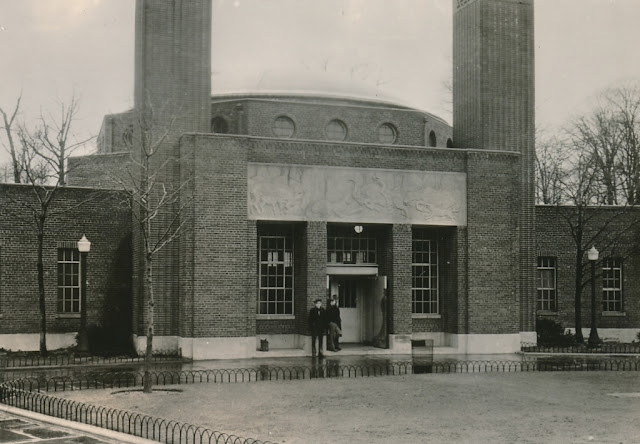
Above: The library building at Brooklyn College, 1936, one of several buildings at the college that were funded by the PWA. Photo courtesy of the National Archives.

Above: "Paper Boquet," a painting by Joseph P. Pandolfini (1906-1987), created while he was in the WPA's Federal Art Project, ca. 1935. Pandolfini had also worked in the New Deal's Public Works of Art Project (PWAP), and the final report of the PWAP showed him living in Brooklyn at 6605 18th Avenue. According to the Genesee Valley Council on the Arts, Pandolfini taught painting at the Brooklyn Museum. Image courtesy of the General Services Administration.


Above: From the Brooklyn Citizen, December 2, 1936, p. 14. Image from newspapers.com, used here for educational and non-commercial purposes.


Above: The caption for this photo, taken ca. 1935-1939, reads: "Floyd Bennet Airport, Brooklyn, New York - Field house, between hangar 5 and administration building." Note the WPA sign on the building. Photo courtesy of the National Archives.


Above: The caption for this WPA photo, taken ca. 1935-1938, reads: "Entrance to one of the group of buildings composing the new Zoo in Prospect Park, Brooklyn, N.Y. From excavation to roofing, including the artwork, the buildings were constructed and equipped entirely by work relief program labor. Brooklyn now has one of the most modern zoos in the country." Photo courtesy of the National Archives.


Above: "Fulton Street, Brooklyn," an artwork by Ann Nooney (1900-1970), created while she was in the WPA's Federal Art Project, ca. 1935-1939. Image courtesy of the General Services Administration.


Above: A WPA poster, advertising a free music performance by the WPA's Federal Music Project, ca. 1935-1939, at 912 Union Street, Brooklyn, New York. Image courtesy of the Library of Congress.


Above: Part of an article from The Brooklyn Daily Eagle, May 2, 1941, p. 19, reporting on an upcoming WPA music event at Prospect Park, featuring pianist Grace Castagnetta (1909-1996). Image from newspapers.com, used here for educational and non-commercial purposes.

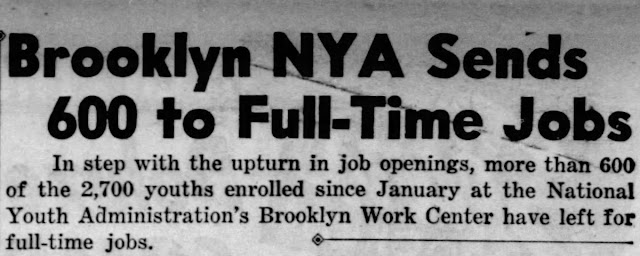
Above: Part of an article from the Daily News (New York, New York), July 13, 1941, highlighting the success of the National Youth Administration's Brooklyn Work Center. The work center was located at 980 Atlantic Avenue. Image from newspapers.com, used here for educational and non-commercial purposes.


Above: NYA enrollees at the Brooklyn Work Center, 1941 (from the newspaper article cited in the previous caption). Image from newspapers.com, used here for educational and non-commercial purposes.


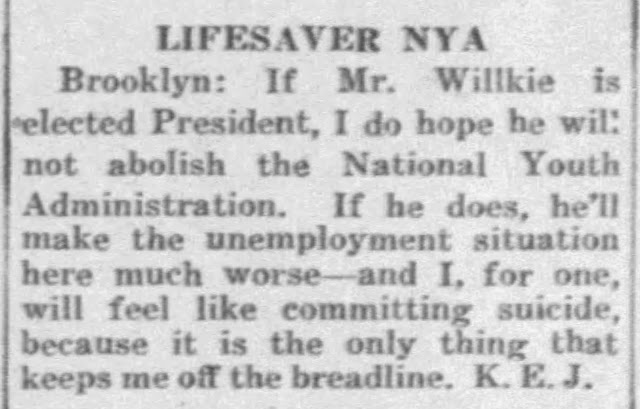
Above: A Brooklyn writer to the Daily News (New York, New York), July 12, 1940, fearing that a Wendell Wilkie presidency might mean the end of the National Youth Administration, which in turn might lead the writer to suicide. Image from newspapers.com, used here for educational and non-commercial purposes.


Above: Part of an article from The Brooklyn Daily Eagle, July 31, 1942, p. 8, noting an upcoming WPA music event at the Brooklyn Museum, including opera singer Edis De Philippe (1918-1978). Image from newspapers.com, used here for educational and non-commercial purposes.


Above: The aircraft carrier Franklin D. Roosevelt at the Brooklyn Navy Yard, October 27, 1945. During the New Deal, the PWA funded many improvements to the Brooklyn Navy Yard, and the Franklin D. Roosevelt was built there from 1943-1945. Public domain photo, courtesy of Wikipedia.