Tuesday, February 4, 2014

Pet Shows or Prisons?

(A pet show in Maryland, 1939, sponsored by the WPA and the local community. Image courtesy of the University of Maryland College Park Archives.)

Pet shows were one of the many types of recreational projects that the WPA assisted local communities with. I don't know too much about the recreational projects, but it seems that the general idea was to offer job opportunities to unemployed Americans who were not well-suited for infrastructure projects (because of their skill-set and employment histories) while at the same time creating activities to bring communities together. Thus, many of the organizers of these recreational projects were probably drawn from the ranks of the unemployed.
 
There can be little doubt that the WPA recreational projects caused anti-government types to scream "wasteful spending!!" And there can be little doubt that we would see the same anger today, if the federal government chose to help local communities and jobless Americans in such a manner. But I have noticed that the type of people who would be against such policies & programs are the same type of people who don't seem to mind that America has the largest prison-industrial complex in the world. Their philosophy seems to be that government should be a hesitant helper...but a very eager prosecutor. And, unfortunately, this mindset has controlled the direction of American government for a long time, as evidenced by (1) our government's refusal to consider a new WPA for millions of long-term unemployed Americans, and (2) our government's expansion of the penal system these past several decades.
 
So, which do you prefer? Pet shows that offer employment and community gatherings, or prisons that facilitate gang activity and generational poverty? Well, it may not matter which you prefer, because our increasingly right-wing government has made the choice for you: Prisons. 
 
But we can resist.    

(WPA poster, courtesy of the Library of Congress Prints and Photographs Division.)

Sunday, February 2, 2014

WPA Poster

(A nice WPA poster, made between 1941 and 1943, by artist John McCrady. Image courtesy of the Library of Congress Prints and Photographs Division.)

Friday, January 31, 2014

The Republican War Against the Long-Term Unemployed

(A WPA orchestra entertains flood victims in Memphis, Tennessee, 1937. As with most WPA projects, it was a win-win situation. Unemployed musicians had jobs, and victims of disaster could enjoy a brief reprieve from the devastation around them. During natural disasters, the WPA also provided shelters, emergency kitchens, restoration of utilities, post-disaster clean-up, and more. This type of action & morality, helping the unemployed while simultaneously providing services to those in need, is largely (or completely) absent in today's America. Today, such action & morality would be scolded as "socialism!!" And so, it seems, we have decided that a government that ignores those in need is better than a government that helps those in need. We have decided that the General Welfare Clause of the U.S. Constitution, unlike the Common Defense Clause, is something to be taken lightly. Image courtesy of the National Archives and the New Deal Network.)

If anything has been made crystal clear during the current Great Recession, it's that people devastated by economic calamity can expect zero help from Republican politicians. And from right-wing extremists, Americans in need can expect even worse: And endless torrent of insults. We've heard it all these past 5-6 years: "Leeches," "losers," "parasites," "moochers," "freeloaders," "takers," "lazy good-for-nothings," and more.

Interestingly though, the venom & vitriol from the political right goes silent when the conversation changes to Corporate America and the big financial institutions, even though these groups--unlike the long-term unemployed--have engaged in insider trading, mortgage & securities fraud, money laundering for drug cartels, interest rate rigging, bribery, accounting fraud, illegal foreclosures on active duty soldiers, and more. For some reason, the tidal wave of white collar crime & mischief that destroyed the economy, and facilitated the need for a massive government bailout of the banks, has been converted by the political right into a problem of "the unemployed are lazy." 

(FDR said he welcomed the hatred of greedy corporate types. But for Americans who wanted jobs, he said "We will provide useful work for the needy unemployed; because, we prefer useful work to the pauperism of a dole!" Today, we see the opposite mentality in our political leaders: They refuse to provide useful work for the needy unemployed, and they bow down before Corporate America. For people who need help, and for people who haven't seen a pay raise in years, this is the ultimate nightmare. It's a ruthless, in-your-face plutocracy. Image courtesy of the FDR Presidential Library and Museum.)

Republican and Tea Party politicians have blocked extended unemployment benefits and have also blocked efforts to protect the long-term jobless from hiring discrimination. Republican and Tea Party politicians even blocked legislation that would have created a new CCC-type program for unemployed veterans, even though there is a suicide problem among young veterans, and even though we know that unemployment and financial stress can lead to suicide (see, e.g., here, here, and here).

There is a Republican War Against the Long-Term Unemployed--a ruthless one. Even Republican Governor John Kasich (Ohio) has noted this: "I’m concerned about the fact there seems to be a war on the poor. That if you’re poor, somehow you’re shiftless and lazy. You know what? The very people who complain ought to ask their grandparents if they worked at the W.P.A." Lately, there have been some high-profile exits from the Republican Party, and those exiting have cited the party's extremism & intolerance as their reasons (see, e.g., here and here).
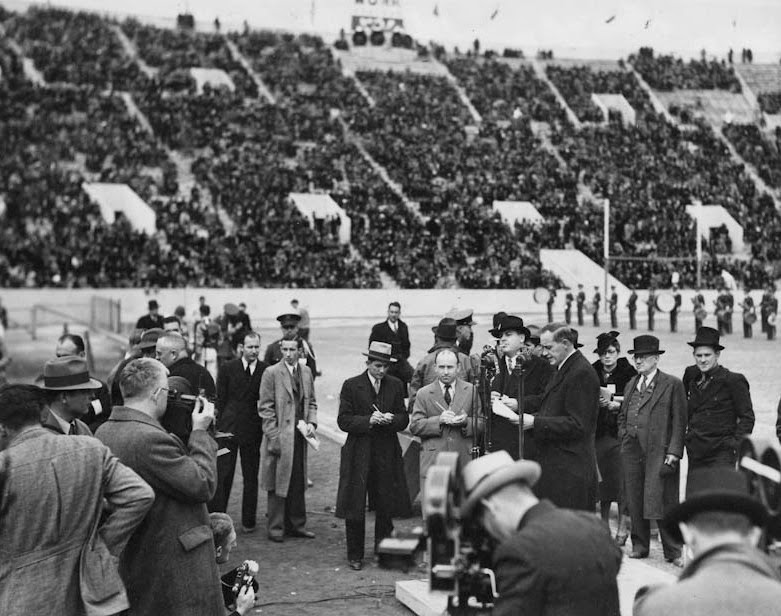
 (Harry Hopkins, head of the WPA and one of the main architects of the New Deal, delivers a speech at the Louisiana State University football stadium (recently improved by the WPA) in 1936. During the speech, Hopkins said "The things they have actually accomplished all over America should be an inspiration to every reasonable person and an everlasting answer to all the grievous insults that have been heaped on the heads of the unemployed." Photo courtesy of the FDR Presidential Library and Museum.)

The Democrats, for their part, are too timid and naive on the problem of long-term unemployment. When the late Senator Frank Lautenberg (D-NJ) tried to create a new WPA for the unemployed, his fellow Democrats displayed their timid nature by twiddling their thumbs and looking the other way as the legislation died in committee. More recently, Obama has prodded businesses to sign pledges that they won't discriminate against the long-term unemployed, in a naive effort to help the jobless (one might forgive Obama for doing the best he can, given Republican and Tea Party obstruction, but why did Obama not offer aggressive support for Lautenberg's WPA bill? Why did he not use the bully pulpit when so many millions were in dire need of help?).

The ruthlessness, timidity, and naivete described above was not always the norm. During the New Deal, policy-makers acted compassionately, boldly, and with common sense. They saw a problem--the private sector casting aside their fellow Americans--and said, in effect, "Alright then, we'll hire them!" And so they did: Well over 10 million jobless Americans were hired into the public work programs of the CWA, CCC, WPA, and NYA. There were jobs for artists, blue-collar workers, white collar workers, older workers, younger workers, men, women, whites, blacks, Indians, and more. And many of the things they created--e.g., works of art, roads, airports, books, research--we still enjoy & utilize today. In fact, many of the people who vilify "big bad government" utilize the creations of the New Deal, completely oblivious to the hypocrisy of their anti-government declarations.


(FDR proposes an Economic Bill of Rights, including "the right to a useful and remunerative job." Sadly, we haven't adopted FDR's proposal, choosing instead to let the unemployed fend for themselves as Corporate America sends good American jobs overseas so that the already-rich can get richer (lower labor & safety costs =  more investment income for the 1%). Worse still, Corporate America pays our Congressmen and women to look the other way, with massive campaign contributions, while they gut the American workforce. Result? America's labor force participation rate is the lowest since 1978, and wages have been stagnant for decades.)

When one sees the ruthlessness, timidity, and naivete of our modern political "leaders" (with a few notable exceptions, like Elizabeth Warren and Bernie Sanders), and then compares that with the tough, no-nonsense, and compassionate leadership of the New Deal, one has to ask, "What in God's name happened?" President Franklin Roosevelt once said "Better the occasional faults of a government that lives in a spirit of charity than the consistent omissions of a government frozen in the ice of its own indifference." Today, facilitated by campaign contributions by the super-wealthy, and exemplified by the Republican War Against the Long-Term Unemployed, we have adopted the opposite philosophy: "Better a cold and apathetic government, than a government that honors the General Welfare Clause of the U.S. Constitution and helps those it is charged with helping."

Thursday, January 30, 2014

The New Deal: Patriotism in its finest form

Above: Funds from the New Deal's Public Works Administration helped repair the Washington Monument in D.C. Image courtesy of the National Archives and the New Deal Network.

Above: The WPA helped repair the Statue of Liberty. Image courtesy of the National Archives and the New Deal Network.

Above: WPA workers restored Fort Ashby in West Virginia, one of several forts built by George Washington. Photo by Brent McKee.
 
 Above: The Civilian Conservation Corps restored the first monument to George Washington, near Boonsboro, Maryland. Photo by Brent McKee.
 
All across the country, New Deal policy-makers and New Deal workers restored, repaired, and preserved American history. Unemployed workers were hired into programs like the CCC and WPA to repair buildings, record oral histories, inventory historic structures, and much more. Many of the buildings they repaired, and many of the records they compiled, are still utilized today, thus highlighting the enduring value of that work.  
 
Some people scoff at the New Deal and call it "godless communism!" and "wasteful spending!" But to my way of thinking, giving your fellow citizens useful work opportunities--opportunities that just-so-happen to preserve our national heritage--is patriotism in its finest form. 

Wednesday, January 29, 2014

Obama's State of the Union and FDR's Alphabet Soup

(President Obama, photo courtesy of Wikipedia.)

Shortly into the 2014 State of the Union address, President Obama lauded "The lowest unemployment rate in over five years." That's when I knew I could turn my television off and find something more productive to do, like fixing a chicken sandwich and watching Tom & Jerry: The Golden Collection. The unemployment rate has dropped, not because the labor market is hunky-dory, but because the jobless are giving up looking for work, and are no longer counted as "unemployed" by the Bureau of Labor Statistics. Think of it this way: If every unemployed person gave up looking for work the unemployment rate would be 0%.

This morning, I read the text of the Obama's speech, and I saw contradictory statements about how (a) the state of our union is "strong" and (b) "average wages have barely budged. Inequality has deepened. Upward mobility has stalled." That's when I knew I had made the right decision to turn the television off. How can our nation be "strong" when the American Dream is dying? I'm reminded of "doublethink" and "newspeak," from George Orwell's 1984.


(Beginning at 14:20, President Obama is introduced and makes his way to the podium. The only thing missing is "We Will Rock You" by Queen. Notice the happy faces of all those in Congress, as Obama makes his way down the aisle. It is indeed a great time to be rich, as most members of Congress are. Unemployment? Homelessness? Stagnant wages? Debt collectors harassing hard-working Americans? Old age poverty looming on the horizon for millions? Bah! Those are the problems of the little people. Most members of Congress spend their days seeking campaign contributions and planning for their lucrative jobs in Corporate America after their political gigs are over. Maybe that's why only 13% of Americans approve of the job Congress is doing which, of course, is a reflection of our own inability to elect people who will truly represent us.)  

I'm not an "Obama hater," as so many millions are, but he doesn't inspire me in any way, shape, or form. He's definitely done some good things, e.g., helping to expand Medicaid and helping to create the Consumer Financial Protection Bureau, but he's too accommodating to Corporate America and big financial institutions, especially in light of the fact that these groups have exported good American jobs and engaged in all manner of fraud. President Franklin Roosevelt said he welcomed the hatred of greedy corporate types, but Obama seems to go out of his way to please them (for example, read this article about the Trans-Pacific Partnership, a trade "partnership" that is sure to lower the standard of living, again, for American workers, while the 1% rakes in more cash).

And Obama's proposed solutions are not only too corporate-friendly, they're just plain underwhelming, as Lynn Stuart Parramore pointed out after Obama's speech: "Instead of tapping into the full power of the federal government to tackle our most urgent problems, Obama meekly suggested that government might, in certain cases, be obligated to do something. A little something. At some point."

(President Franklin Roosevelt, photo courtesy of the Library of Congress Prints and Photographs Division.)

Unlike the timid, ambiguous, and fraudster-friendly policy "solutions" that we're subjected to today, FDR and his New Deal policy-makers took bold & decisive steps to help Americans. Their alphabet soup of programs--TVA, FDIC, WPA, CCC, and many more--mitigated the misery of the Great Depression, set the stage for America's post-WWII economic prosperity, and created the physical and policy infrastructure needed for middle-class growth in subsequent decades.

In last night's State of the Union speech, President Obama used the two happy words that we've heard for the past 5-6 years: "Innovation" and "Entrepreneur." Heck, he even rhymed with them: "And let’s pass a patent reform bill that allows our businesses to stay focused on innovation, not costly, needless litigation." The words "innovation" and "entrepreneur" have been used, I think, more often than any other words since the start of the Great Recession. They've been used to mask structural unemployment problems, and to justify the lack of stronger action. Those with good jobs and prestigious positions in government, business, and academia, tell those who can't find good jobs, "Hey, be an entrepreneur! Be innovative!" It's nonsense, of course, uttered by those who are not desperate for work.

Unemployed & underpaid Americans would be better off if the powers-that-be adopted New Deal policies, and stopped droning on about "entrepreneurs" and "innovation." We don't need happy words, we need jobs and raises. We need some alphabet soup.


(Probably the most interesting thing to come out of the State of the Union event was Republican Congressman Michael Grimm's threat to throw reporter Michael Scotto off the "f*&king balcony." Scotto had inquired about an ethics investigation into campaign contributions Grimm has received. Our political "leaders" don't like it when you ask about where they're getting their money from, so Grimm warned Scott that if he ever did that again, "I'll break you in half. Like a boy." Yes folks, this is our Congress. Demonizing the less fortunate, getting campaign cash from questionable sources, and then threatening to throw people off the "f*&king balcony." Is it any wonder that the American Dream has gone the way of the Dodo Bird?)

Tuesday, January 28, 2014

The Pseudo Job-Creation of Tom Perkins vs. the Real Job-Creation of the New Deal

The Pseudo Job Creation of Tom Perkins:


In the interview above, multi-millionaire Tom Perkins apologizes for using the word "Kristallnacht" to describe the criticism that that the 1% endures from progressives.

Perkins also tells us that America's "creative 1%" are threatened, that the 1% are "job-creators," that "opportunities" are created as the 1% gets richer, and that our economy needs less taxes, less regulations, and less government, so that the 1% can do what they do best--create jobs and opportunities. Yippee, it sounds so magical and comforting!

Perkins is either willfully deceiving us or he is completely oblivious to the fact that (a) the 1% is already enjoying historically low tax rates, (b) the 1% now controls a historically high share of our nation's wealth, and (c) we do have less government, as evidenced by lower federal revenue (when measured as a % of GDP), underfunded regulatory agencies, lower public sector employment, and the presence of numerous Congressmen and women who are paid by right-wing campaign contributors to sabotage our government.

In sum, we have everything that super-wealthy conservatives want (except for complete anarchy), yet the so-called job-creators are still not creating good-paying jobs. What we have is a never-ending cycle of lunacy, where the richer the 1% gets the more they--and they're followers--claim that "onerous taxes" are sapping their job-creation super powers.

How much more of this pseudo job-creation can we take?

The Real Job Creation of the New Deal:

(Image courtesy of the Library of Congress Prints and Photographs Division.)

President Franklin Roosevelt and his New Deal policy-makers created jobs in three major ways:

1. They created public job programs like the CCC, CWA, and WPA, and these programs hired well over 10 million different Americans during the Great Depression.

2. They created or advanced a set of policies, programs, and agencies--including minimum wage law, unemployment insurance, Social Security, FDIC, and the Securities & Exchange Commission--that created greater social stability and greater banking stability. For example, bank failures after FDIC were much less frequent than before FDIC. 

3. Through the Public Works Administration (PWA), and also through the aforementioned public job programs, they spent large amounts of money on American infrastructure. The result? After World War II, the economy expanded along New Deal roads, across New Deal bridges, inside New Deal buildings, and out of New Deal airports. America became the economic powerhouse of the world on the back of New Deal infrastructure. Unemployment was low, business grew, the middle-class expanded, and opportunities were numerous (and guess what? people still became very wealthy).

This is job-creation, the New Deal way. No narcissism from the 1% needed.

Monday, January 27, 2014

California drought, transporting water, and Krugman's "Learned Helplessness"

(WPA workers installing a water line in Maryland, in December of 1935. Between 1935 and 1943, WPA workers installed over 16,000 miles of new water lines. That's enough water line to go from Washington, D.C. to San Francisco, and back again, three times. Photo courtesy of the University of Maryland College Park Archives.)

California is experiencing severe drought conditions, and it could get worse. California is also plagued by wildfires and, because of the drought conditions, the wildfires could become more frequent and severe in years to come.

There is an that idea pops up from time to time to address persistent drought: Move water from areas that routinely experience floods to areas that routinely experience drought. To this idea I would add the following: Hire and train unemployed Americans to perform the task--with the assistance of private contractors and the Army Corps of Engineers--and you will have a win, win, and win situation: The unemployed will have useful work (and a restoration of hope), private firms will have more business, and droughts & wildfires will become less severe.

 (The Central Arizona Project, the largest aqueduct system in the United States, carries water from the Colorado River to central and southern parts of Arizona. The main system is 336 miles long and was built from 1973 to 1993 (see history here). This aqueduct cost $4 billion to construct and highlights what we can do when we put $4 billion towards the common good, instead of creating policies (e.g., colossal tax breaks for the wealthy) that give $4 billion to a single individual who, in turn, uses that fortune to manipulate federal, state, and local governments through massive campaign contributions. Photo courtesy of Wikipedia.)

There's one major problem with trying to create a public works project to move water from flood-prone areas to drought-stricken areas (and hiring the unemployed to perform much of the work). It's not an engineering problem, but a problem that Nobel-winning economist Paul Krugman pointed out two and a half years ago: "Learned Helplessness." Krugman wrote: "As I see it, policy makers are sinking into a condition of learned helplessness on the jobs issue: the more they fail to do anything about the problem, the more they convince themselves that there’s nothing they could do."

I would expand the "Learned Helplessness" concept to cover over our entire society. We are being conditioned to believe that large undertakings for the common good are "not serious" or "not practical." So, we fail to act and the results are destructive droughts, record-setting wildfires, rising rates of suicide (due, in part, to unemployment), and wealth inequality so enormous that the 400 richest Americans now have as much wealth as the entire African American population of the United States. We are being conditioned to believe that projects undertaken for the common good are "radical" or "socialist," but a system that enriches the already-rich, while everyone else lives in perpetual fear of unemployment and poverty, is necessary for "economic growth" (those two wonderful words that have become code for "more money for the 1% and less for everyone else"). In sum, we're being conditioned to be stupid.  

 (The CCC employed jobless young men to, among other things, fight wildfires. Even though it worked then, a CCC would not be possible today. A new CCC would require democracy, but America has become a plutocracy. The 1% controls Congress, and they have no need for a public jobs program. They're getting wealthier and wealthier and that's all that matters (see interesting research on the policy preferences of the wealthy here, particularly table 5 on p. 57). Hence, unemployment, stagnant wages for those who do work, and record-setting wildfires will continue to be the norm. Photo courtesy of the Oregon State University Archives.)

(The Thomas Viaduct carries trains over the Patapsco River and the Patapsco Valley, in central Maryland, and is a vivid example of what can result when we reject the Learned Helplessness that plutocrats are indoctrinating us with. According to the book Historic Bridges of Maryland (2002) by Dixie Legler, Carol Highsmith, and the Maryland State Highway Administration, "People scoffed when Benjamin Henry Latrobe began building his 612-foot-long stone bridge over the Patapsco River. 'Latrobe's Folly,' as some doubters called it, opened in 1835 and has been in continuous service between Baltimore and Washington, D.C. ever since...the bridge has carried every type of locomotive from the original six-ton engines of the 1800s to the three-hundred-ton engines of today without requiring any major repairs or modifications, confirming the stunning misjudgment of early skeptics." Image courtesy of Wikipedia, CCA-SA 3.0 Unported License.)

The truth is, we can do many things that we are told we can't. Many of the people who tell us that large infrastructure projects are "zany" or "wacky" are the same people who make millions (or billions) by demonizing the government & demonizing the less fortunate, while giving millions to politicians to make sure our government is no longer ours. Or, they are people who receive funding from these millionaires and billionaires, to produce "serious" research about why we can't afford to help ourselves. And, as repulsive as that is, we also have to look in the mirror and ask, collectively, "Why are we buying, believing, and submitting to this garbage?"