Monday, September 8, 2014

How the New Deal Helped Win World War II (part 4 of 10): WPA Posters--Art to Inform & Rally the Nation

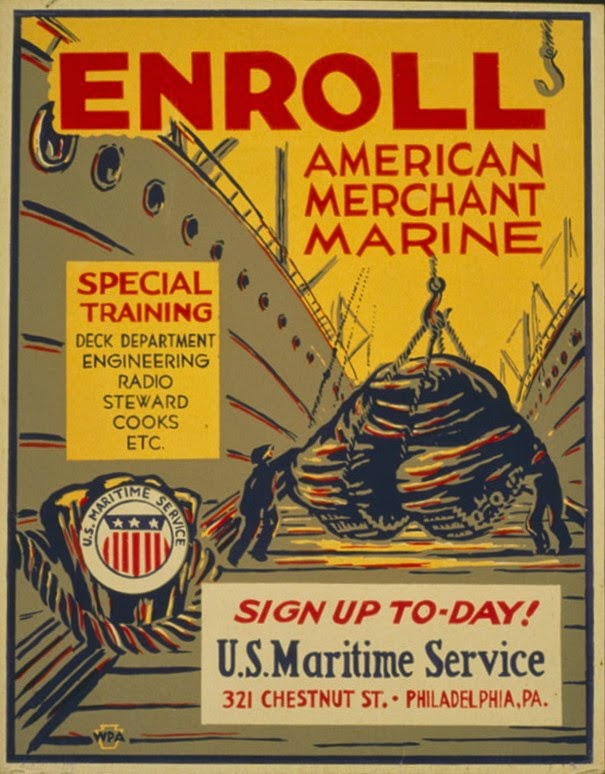
(WPA poster by artist Charlotte Angus, made in Pennsylvania between 1941 and 1943. Image courtesy of the Library of Congress Prints and Photographs Division.)

During the war years, WPA artists designed many posters to inform and rally the nation. Some posters urged Americans to refrain from talking about war-related activities, while others encouraged Americans to support the war effort by purchasing war stamps and war bonds. There were other posters that asked for volunteers, requested material donations, promoted salvage activities, urged water conservation, and much more.

Every American could participate in the war effort, whether overseas in uniform or at home in civvies. WPA artists did their part by creating a wide variety of public information posters. Here are just a few examples (all images courtesy of the Library of Congress Prints and Photographs Division):

(Artist: Edward T. Grigware)

(Artist: Unknown)

(Artist: William B. Finley)

(Artist: Edward T. Grigware)

(Artist: Unknown)

(Artist: Glenn Stuart Pearce)

(Artist: Unknown)

(Artist: Thomas A. Byrne)

(Artist: Glenn Stuart Pearce)

(Artist: Unknown)

(Artist: Unknown)

(Artist: Unknown)

(Artist: Phil Von Phul)

Sunday, September 7, 2014

How the New Deal Helped Win World War II (part 3 of 10): The CCC Helped Mobilize the Nation

(WPA poster by artist Albert M. Bender, made in Chicago, 1941. Image courtesy of the Library of Congress Prints and Photographs Division.)

In the American Experience/ PBS documentary The Civilian Conservation Corps (2009), veteran Houston Pritchett described how his experience in the CCC prepared him for military service: "Nobody had to tell you how to make a bed, and how it should be done. How to clean your clothes. And they didn't have to tell you that if the man tell you to go do something, you didn't ask questions, you do it. The CCC made me a man. Made me respect discipline, and how to work and get along with people."

(FDR and some of his New Deal colleagues are surrounded by FDR's forest army--the Civilian Conservation Corps. This photo was taken in Virginia, 1933. Provided courtesy of the FDR Presidential Library and Museum.)

In an interesting journal article (citation below), military historian and author Charles E. Heller (Ph.D. University of Massachusetts-Amherst / Col. Ret. U.S. Army Reserve) wrote, "...the CCC better prepared the U.S. Army for the challenge of mobilizing for war by providing [a] pretrained officer and NCO leadership base that helped to win the Second World War."

Heller explains that the U.S. Army was only the seventeenth largest in the world before the war, but was able to expand from 187 thousand to 8 million "in a relatively short time." Heller's research describes why men who went through the CCC program were often quickly promoted to sergeants in the Army. In sum, the physical fitness, education, work ethic, interpersonal skills, discipline, and leadership skills that the men acquired in the CCC set them apart from other draftees and volunteers. Hence, the CCC veterans were able to help the Army mobilize because they were, in very short order, ready to assume leadership positions.

Heller quotes General Mark Clark, the commander of the Allied Fifth Army during World War II: "To my way of thinking the CCC...became a potent factor in enabling us to win WW-II...though we did not realize it at the time, we were training Non-Commissioned Officers."

Heller also points out that CCC veterans who did not serve in the armed forces often took their enhanced work ethic & skills into the defense industries (thereby still improving America's war-readiness). Further, the CCC gave Army Reserve officers (men who volunteered to lead CCC camps) experience that helped them later on. For example, after serving as a commander in the CCC, Captain Burdwell H. Shipe volunteered for active duty in 1940 and was assigned to Fort Meade (Maryland). Shipe was ordered to prepare 150 new Army inductees: "I knew exactly what to do and where to go to get what I needed because of my CCC experience."

(Charles E. Heller, "The U.S. Army, the Civilian Conservation Corps, and Leadership for World War II, 1933-1942," Armed Forces & Society, April 2010, vol. 36, no. 3, 439-453.)                 


(A nice 7-minute presentation on the Civilian Conservation Corps, from Iowa Public Television. Includes lots of interesting old footage, as well as recollections from CCC veterans. You can adjust the resolution by using the gear tool in the lower right-hand corner of the video player. Original YouTube link: http://www.youtube.com/watch?v=8XJkxJ--EtM.) 

In Perry H. Merrill's book Roosevelt's Forest Army: A History of the Civilian Conservation Corps (1981), many CCC veterans explained how their time in the CCC prepared them for military service. Here are a few of the recollections:

"When I left there in 1940, I felt that the 3C's had done more for me than I could have learned in a good trade. Soon I joined the Army and came out as a technical sergeant."
--Arlington Kane

"I would not take anything for the experience and help that I received during my five years as a member. I feel that I benefited from it when I went into the service."
--Unnamed CCC veteran from Oklahoma

"There was a 3/4 ton Bay City Shovel...I learned how to run heavy equipment...When I got in the army, I worked at the Boston shipyard running a crane, so that is where that little Bay City Shovel started me in the CCC."
--Robert Hartwell

"I credit my experience in the CCC with my fast promotions when I suddenly found myself in the U.S. Army in 1941. Because of my camp life experiences I was made barracks leader my first day in the army, acting corporal all during basic training and promoted to First Sergeant on the thirteenth month. I stayed in the army for a total of 22 years and retired in 1962 in the grade of Major of Engineers."
--J.D. English, Jr.

(CCC enrollees not only worked in the forests, but also worked in shops and gained skills operating machinery. Photo courtesy of the National Archives and the New Deal Network.) 

Will we learn from the history of the CCC, forests & parks, and World War II? 

In his article about the Army, the CCC, and leadership, Heller wrote of the CCC boys: "They represented a full spectrum of American youth ranging from college students to boys who had not completed high school...The one thing they had in common was unemployment." In the American Experience/PBS documentary The Civilian Conservation Corps, journalist & author Jonathan Alter said, "The CCC Corps members came from very different backgrounds...The only thing they had in common was that they were poor."

Unemployed and poor.

Today, the unemployed and poor have been labeled by many politicians, political commentators, and radio show hosts as "takers," "free loaders," "lazy pigs," and people "who do not know how to do a day's work." (And when we tried to create a new CCC-type program for unemployed veterans, Republicans blocked it.)

The same type of insults were leveled against the poor and unemployed during the Great Depression. Many of those with jobs simply could not understand how those without jobs could have possibly ended up in that situation. "It must have been their lazy, immoral, or unskilled characteristics!" (Like today, many people chose to blame the individuals rather than the structural problems within the economy. Today, structural problems include job outsourcing, machines replacing workers, wide-scale corporate lawlessness, and discrimination against the long-term unemployed.)

A great thing happened when FDR and his New Deal colleagues created the CCC and gave the unemployed opportunities instead of insults: Three billion trees were planted, large areas of forest were protected from fire, 800 state parks were developed (that we still enjoy today, by the way), and the men of the CCC helped us win the war by filling important leadership roles and, in many cases, sacrificing their lives.

So, what are your thoughts? Is it more productive to cast the unemployed as "parasites," or is it more productive to give them work opportunities? This is an important question, because unemployment rates for young adults are still in the double-digits.

Friday, September 5, 2014

How the New Deal Helped Win World War II (part 2 of 10): New Deal Ships

 Above: According to Dr. William M. McBride, professor of history at the U.S. Naval Academy, "The battleships North Carolina (shown above) and Washington were the first capital ships to fall under the control of New Deal legislation" ("The Unstable Dynamics of a Strategic Technology: Disarmament, Unemployment, and the Interwar Battleship," Technology and Culture Vol. 38, No. 2 (Apr., 1997), pp. 386-423, 417). The North Carolina's construction began in 1937, commissioning occurred in 1941, and she was decommissioned in 1947. The North Carolina became a museum/memorial ship in 1962, and can be visited today in Wilmington, North Carolina. According to the Historic Naval Ships Association, "North Carolina is the most decorated U.S. battleship of World War II with 15 battle stars, having participated in every major naval offensive in the Pacific from Guadalcanal to Tokyo Bay. She is also credited with kills of 24 aircraft, a merchantman and the bombardment of nine Imperial Japanese strongholds." Image courtesy of Doc Searls and Wikipedia, used under the Creative Commons Attribution-Share Alike 2.0 Generic license.

Above: The U.S.S. Enterprise, built with PWA funding, played a critical role in America's victory in the Pacific. For example, "In June 1942, Enterprise played a vital role in the Battle of Midway, in which her planes sank or helped sink three Japanese aircraft carriers and a cruiser" (link). The Enterprise was decommissioned in 1947. Above, we see the Enterprise heading towards the Panama Canal in October of 1945. Photo courtesy of the U.S. Navy.

Above: A WPA poster, created by artist Robert Muchley, in Pennsylvania, between 1941 and 1943. Image courtesy of the Library of Congress Prints and Photographs Division.

Dr. Daniel Goure, of the somewhat right-leaning Lexington Institute, wrote "Both organizations (the WPA and PWA), but primarily the PWA, turned out to play major roles in the American victory in World War Two. It was the PWA that funded construction of the aircraft carriers Yorktown and Enterprise whose aircraft were responsible for sinking the four Japanese aircraft carriers...In addition, the PWA funded the construction of four cruisers, four heavy destroyers, many light destroyers, submarines, planes, engines, and instruments...The PWA and the WPA helped mitigate the effects of the Great Depression while also making the world safer for democracy."

In his book Long-Range Public Investment: The Forgotten Legacy of the New Deal (University of South Carolina Press, 2007), Dr. Robert D. Leighninger, Jr., highlights some of the PWA funding for the Coast Guard and Navy: "An allotment of $1.5 million to the Coast Guard built several kinds of airplanes for patrol and rescue operations. Another $2.8 million produced five 165-foot Coast Guard cutters. Most impressive was what PWA did for the Navy. It might surprise most people to learn that the aircraft carrier Yorktown, sunk in the Battle of Midway, was a New Deal public works project. In addition to the Yorktown, PWA funded the carriers Ranger and Enterprise, seven heavy cruisers, four light cruisers, five submarines, and thirty-two destroyers." 

Some people say that the New Deal was just a giant boondoggle, and that we would have been better off without it. What do you think?

Thursday, September 4, 2014

How the New Deal Helped Win World War II (part 1 of 10): TVA Power


(In this interesting 3-minute video, we see the TVA constructing Norris Dam in Tennessee, circa 1933-36. The video appears to have been made, in part, to highlight the durability of Chevrolet trucks. This is interesting, because it shows how government infrastructure initiatives can spur the growth of private sector business. Original YouTube link here: 
https://www.youtube.com/watch?v=orNmfMsxkO4.)

In the early 1930s, President Franklin Roosevelt and his New Deal colleagues created the Tennessee Valley Authority (TVA) to produce power for Tennessee and surrounding areas. The TVA has been a success for over three-quarters of a century--so much of a success, in fact, that even today's Republican politicians protect it from privatization proposals (see "Obama Proposal To Sell TVA Blasted By Republicans"). And, in addition to providing much needed energy to American homes and businesses, TVA played a critical role during World War II, as was highlighted in an excellent 2008 documentary:  

"The United States learned of Germany's plans to build an atomic bomb. To win the war, the U.S. had to build the bomb first. The site for the atomic laboratory required two things: Secrecy and power. Tennessee was the answer. It had rugged mountains and, most importantly, TVA" (Built for the People: The Story of TVA, a Documentary Channel and Fine Films production).

The quote above refers to the testing & development facilities at Oak Ridge, Tennessee. It was at Oak Ridge that the Hiroshima bomb was built. The bomb caused a massive loss of life but also helped end World War II.

There were other TVA war activities:

"TVA made a number of key contributions to the war effort. Its mapping department, based in Chattanooga, Tennessee, used aerial reconnaissance and techniques perfected in the course of mapping the TVA region to make crucial maps of Europe for Allied aviators. Its nitrate plants in Muscle Shoals, Alabama, supplied the raw material for thousands of tons of munitions, as well as fertilizer to help grow food in beleaguered Allied countries. But TVA’s main contribution lay in producing enormous amounts of electric power...For all its accomplishments before and since, TVA’s star may never have shone brighter than when it helped win America’s biggest war." (To learn more, see "TVA Goes to War," Tennessee Valley Authority, http://www.tva.com/heritage/war/.)

Some say the New Deal was nothing but wasteful spending. What do you think?

Wednesday, September 3, 2014

New Deal Nutrition vs. Trickle-Down Nutrition

(WPA poster, courtesy of the Library of Congress Prints and Photographs Division.)
 
A recent study in the Journal of the American Medical Association Internal Medicine finds that "Low-income people’s diets have gotten worse over the past decade as richer people’s nutrition has been improving." 

So here we have yet another bad result from the soaring income & wealth inequality that trickle-down economics has inflicted on us for the past 30+ years (see, e.g., "Study Says America's Income Gap Widest Since Great Depression"). Over the past several years--as we have watched corporate profits rise--we have seen median household income drop, the middle-class shrink, the American Dream become a myth, and our nutritional needs remain unfulfilled.

(The description for this photo reads, "Three WPA gardening projects in Denver, Pueblo and Greeley will produce approximately 665 tons of vegetables for distribution to indigent families receiving direct relief. A million cans of vegetables grown and processed by WPA workers will be distributed in these three cities under the supervision of the State Department of Public Welfare and county government. Shot shows beans being shelled." Photo courtesy of the National Archives and the New Deal Network.)
 
During the New Deal, policymakers worked very hard to address the nutritional needs of all Americans. There was a WPA school lunch program; young men in the CCC were well-fed; there was a surplus commodities program to deliver food to those in need; community gardening programs were set up so that people could get more fresh fruits & vegetables; thousands of miles of new water lines were installed, along with hundreds of thousands of consumer water connections; farm-to-market roads were created to bring fresh farm goods to more Americans; and much, much more.
 
Our diets today could really use a New Deal. 

Tuesday, September 2, 2014

The Reverse New Deal: Los Angeles crumbles, federal aid dries up, regressive taxation is proposed, and tax evasion & avoidance runs rampant

(In the photo above, WPA workers are building a sidewalk in Allegany County, Maryland. In Los Angeles, "More than 4,000 of the 10,750 miles of sidewalks are in severe disrepair." Photo courtesy of the University of Maryland College Park Archives.)

The New York Times ran an interesting article yesterday, "Infrastructure Cracks as Los Angeles Defers Repairs." In the article, we learn that Los Angeles has serious problems with its roads, sidewalks, and water lines--problems that have caused massive water loss, lawsuits, and expensive auto repairs for its citizens.

To me, the most interesting aspect of this story is that it highlights how Republican policies shift the revenue burden away from millionaires & billionaires (who can afford it), towards the middle-class & poor (who are struggling to make ends meet). In the article, we learn that (a) Los Angeles's infrastructure problem "is exacerbated by cutbacks in federal spending on public works" and (b) conservative talk show host and public official Kevin James is calling for a sales tax increase--a tax increase that would disproportionately affect the middle-class and poor (sales taxes are highly regressive).

This same phenomenon is happening all across the country. Instead of increased federal aid for infrastructure (such increases are routinely blocked by Republican and Tea Party politicians) we see increased & regressive taxes, tolls, fees, and fines at the state & local level. In my home state of Maryland, for example, the toll to cross the Chesapeake Bay Bridge went from $2.50 to $6.00 in just 2-3 years--a 140% increase (bridge tolls, like sales taxes, are highly regressive). 

Federal aid could be increased, of course, by raising tax rates on the super-wealthy (tax rates that are now historically low), and also by cracking down on super-wealthy tax cheats (we lose about $300 billion--per year--due to tax evasion, practiced largely by the super-wealthy--see here and here). But Republican and Tea Party politicians are actively working to protect the super-wealthy from paying more, with a two-pronged strategy: First, as we all know, they work hard keep tax rates low on the super-wealthy. And second, they work hard to protect super-wealthy tax evaders from law enforcement. See, for example: "Republicans bash U.S. law targeting offshore tax dodgers" and "Policing Tax Evasion Could Save Billions, But Republicans Won't Fund Enforcement." As Heather Lowe of Global Financial Integrity said, "It is mind-boggling that a major political party would even consider endorsing a resolution to facilitate tax evasion."

(In the photo above, WPA workers are on a road project in Baltimore, Maryland. In Los Angeles, "The average car owner here spends $832 a year for repairs related to the bad roads..." Photo courtesy of the University of Maryland College Park Archives.)

During the 1930s and 40s, New Deal policymakers funded massive infrastructure improvements. For example, the CCC developed hundreds of state and national parks, the PWA funded the work of private contractors, and the WPA hired the unemployed to build or improve thousands of bridges, buildings, airports, and more. A researcher at the time noted, "So vast have the WPA's achievements been that attempts to present them in quantitative terms only stagger the imagination" (Donald Howard, The WPA and Federal Relief Policy, p. 126, New York: Russell Sage Foundation, 1943).

Middle and low-income Americans, who have seen their household income drop as corporate profits have soared, desperately need a new and even stronger New Deal. Unfortunately, as our country descends further and further into plutocracy, all they're going to get are increased taxes, tolls, fees, and fines.

Welcome to the Reverse New Deal.

Monday, September 1, 2014

A New Deal Labor Day

(WPA workers constructing the Fort Hill High School football stadium in Cumberland, Maryland, 1937. WPA workers created or improved thousands of the recreational areas that Americans will use this Labor Day holiday--golf courses, tennis courts, parks, and more. Photo courtesy of the University of Maryland College Park Archives.)

According to the U.S. Department of Labor, Labor Day "is a creation of the labor movement and is dedicated to the social and economic achievements of American workers. It constitutes a yearly national tribute to the contributions workers have made to the strength, prosperity, and well-being of our country."

Of the WPA, President Franklin Roosevelt wrote "(The WPA) has added to the national wealth, has repaired the wastage of depression and has strengthened the country to bear the burden of war" (Final Report on the WPA Program 1935-43, Washington, DC: U.S. Government Printing Office, 1946). Even limited-government icon Ronald Reagan seconded this appraisal, writing positively about the WPA in his autobiography.

Interestingly though, during this Labor Day you are unlikely to hear much from our mass media or political "leaders" about the laborers who participated in the New Deal work & construction programs, e.g., the WPA, the National Youth Administration (NYA), or the Civilian Conservation Corps (CCC), despite the fact that these workers--along with private sector workers funded by the New Deal's Public Works Administration (PWA)--modernized our infrastructure on a scale never seen before or since.

It's hard to determine why the mass media and our political "leaders" will, for the most part, fail to mention these New Deal laborers. Is it cultural forgetfulness? Is it because Labor Day sales and "news" about Kim Kardashian's wardrobe choices will drown out the more substantive aspects of Labor Day? Is it because we have a collective disdain for the unemployed and thus don't care to mention their monumental, nation-changing achievements? (See "Matt Taibbi: America Has A 'Profound Hatred Of The Weak And The Poor'"). Is it because many on the political right would prefer to believe that Ayn Rand was responsible for the modernization of America, and not workers or "big bad government"? Is it all of the above?  

In any event, please take a moment to remember the millions of New Deal laborers who built or improved so many of the parks, bridges, roads, buildings, airports, etc., that we still enjoy & utilize today (see the Living New Deal for thousands of still-existing New Deal sites, structures, and works of art).