Wednesday, October 8, 2014

Water main break in Dimmit County, Texas: Schools closed, businesses closed, and medical services put in danger. A new WPA could have prevented that.

(WPA workers installing a water line in Hebron, Maryland, 1940. Photo courtesy of the University of Maryland College Park Archives.)
 
On Monday, October 6, 2014, a water main broke in Dimmit County, Texas, forcing schools & businesses to close and also threatening medical services. "The cause of the water main break is being blamed on aging infrastructure." (See "Water returns to Carrizo Springs")
 
During the New Deal, WPA workers installed 655 miles of new water lines in Texas. That's enough water line to extend from Dallas to El Paso.
 
As American infrastructure continues to crumble (we have, for example, an average of 657 water line breaks per day), and as schools, small businesses, and medical services are threatened, the richest 400 Americans have seen their wealth rise to $2.29 trillion and Corporate America is acquiring record profits (see, e.g., "Corporate profits hit record as wages get squeezed"). Also, we spend as much on military operations as almost every other nation on the planet combined (see, e.g., "U.S. Military Spending Dwarfs Rest of World").

Many on the political right say that we're broke and can't afford to do anything. Do you believe them?

Tuesday, October 7, 2014

Bridgeton, New Jersey lost its water supply. A WPA could have prevented that.

(Image courtesy of www.clker.com.)

This past Monday, October 6, the city of Bridgeton, New Jersey lost its water supply, leaving schools closed and homes without water. "The cause of the water main break was due to extremely old piping, according to the public works director." (See "Bridgeton water main break leaves city with little to no water, officials say")

A new WPA, if created during the height of the Great Recession, could have replaced that old pipe by now--as well as thousands of other old pipes that are contributing to the 657 daily water line breaks across the United States.

Unfortunately, most of our federal policymakers have been too busy these past 6+ years protecting their billionaire sugar daddies from increased taxation, and also thinking up new ways to insult the unemployed (to score some quick political points), to worry about our crumbling infrastructure. And even when infrastructure bills are introduced, they are quickly killed by our conservative "leaders" in Congress (see, e.g., "Senate GOP blocks $60B Obama infrastructure plan"). As a journalist for Time magazine rightly noted, "no matter how much Republicans say they care about infrastructure, they’re not going to accept any infrastructure proposals that come from President Barack Obama."

But for future policymakers, who may (hopefully) harbor less hatred towards their president, and less hatred towards the unemployed, here is some important information:

New Deal policymakers gave millions of unemployed Americans jobs in the WPA. These unemployed Americans modernized our nation's infrastructure on a scale not seen before or since (for example, WPA workers installed 16,000 miles of new water lines). We are still utilizing much of this infrastructure today, in many cases past its intended lifetime. Even limited-government-icon Ronald Reagan praised the work of the WPA in his autobiography.

(A poster highlighting some of the infrastructure work of the WPA. Image courtesy of Wikipedia.)

Today, there are still 3 million long-term unemployed Americans, 23 million Americans who wish they had a full-time job but can't find one, the labor force participation rate is at a 36-year-low (meaning that there are an awful lot of Americans sitting on the sidelines, having abandoned hope that they are welcome in the American workplace), and the American Society of Civil Engineers, in its latest infrastructure report card, gave American infrastructure a letter grade of D+. 

Isn't it time for some new thinking?

Monday, October 6, 2014

The Precariat, the Plutocrats, and the New Deal

(WPA workers on a road project in Maryland, 1937. When Americans needed jobs during hard times, New Deal policymakers gave them jobs. Photo courtesy of the University of Maryland College Park Archives.)

Well, we received our happy news last week, the unemployment rates is down to 5.9%! Yippee!

Unfortunately, in other news, the labor force participation rate is at a 36-year-low, there are 23 million Americans who wish they had a full-time job but can't find one, and wages are still stagnating for the middle-class and poor (even though their productivity is up). In other words, tens of millions of Americans are running in circles, if running at all.

On the bright side, the rich are doing better than ever! "All together the 400 wealthiest Americans are worth a staggering $2.29 trillion, up $270 billion from a year ago" ("Inside The 2014 Forbes 400: Facts And Figures About America's Wealthiest"). Indeed, over the last few years we have watched two things rise in sync with one another: The wealth of the wealthy and the poverty of children (see, e.g., "Childhood poverty rates on the rise").

Leo Gerard, the International President of the United Steel Workers, wrote an interesting op-ed today, titled "Good People Don't Get Good Jobs." Gerard highlights the dismal lives of marginalized workers: "They live precariously, without health insurance, without a living wage, without a schedule for duty, without a guarantee of work the next week or month. This mounting army of workers worries incessantly and survives only because of government and family assistance. CEOs and corporations gorge themselves on profits made on the suffering of workers trapped in this life of frightening instability called the precariat."

According to a professor at the University of Bath, England, the precariat "consists of a multitude of insecure people, living bits-and-pieces lives, in and out of short-term jobs, without a narrative of occupational development, including millions of frustrated educated youth who do not like what they see before them, millions of women abused in oppressive labour, growing numbers of criminalised tagged for life, millions being categorised as ‘disabled’ and migrants in their hundreds of millions around the world. They are denizens; they have a more restricted range of social, cultural, political and economic rights than citizens around them."  

Yep, that sound about right.

Unfortunately, we may have reached a point of no return. Corporate America and the super-wealthy have used their enhanced riches to buy our electoral & political processes, and thus our government. And millions of Americans--susceptible to the slick, deceptive marketing perpetrated against them by Corporate America and the super-wealthy--continue to vote against their own economic interests. Millions of others don't even bother to vote.

 (President Franklin Roosevelt. Photo courtesy of the FDR Presidential Library and Museum.)

In an April 1938 speech to Congress, President Franklin Roosevelt warned us that "The first truth is that the liberty of a democracy is not safe if the people tolerate the growth of private power to a point where it becomes stronger than their democratic state itself. That, in its essence, is fascism -- ownership of government by an individual, by a group, or by any other controlling private power."

So, the question today is: Will we tolerate it? 

In the same speech, Roosevelt said: "No people, least of all a democratic people, will be content to go without work or to accept some standard of living which obviously and woefully falls short of their capacity to produce. No people, least of all a people with our traditions of personal liberty, will endure the slow erosion of opportunity for the common man, the oppressive sense of helplessness under the domination of a few, which are overshadowing our whole economic life."

My fear is that Roosevelt is wrong here, for it certainly seems as though we are content with what is happening, and quite willing to endure it. Yes, there are pockets of resistance but, by and large, there is no great mass movement for change. Millions continue to vote for politicians who are funded by Corporate America and the super-wealthy (and millions don't vote at all). So, we can expect misery to keep growing for the 99%, and wealth to keep growing for the 1%.

We need a new and stronger New Deal. Unfortunately, all we have right now is the precariat and the plutocrats.

Sunday, October 5, 2014

You don't have a right to water, but you do have a right to spend as much as you want to create a plutocracy

(WPA workers installing a water line in Maryland, 1938, for the public. Photo courtesy of the University of Maryland College Park Archives.)

Recently, a bankruptcy judge in Detroit declared that people do not have a right to water service, not even a "service based on an ability to pay." This seems to indicate that governments and corporations can charge whatever they want for life-sustaining water. And indeed, "Over the last decade, Detroit residents have seen water rates rise by 119 percent" (see here).

We also know that the Supreme Court has been judicially active in recent years by granting Corporate America and the super-wealthy the right to spend as much as they want to manipulate our electoral and political processes, by linking political spending to free speech. Money is now speech, and so the wealthier you are the more powerful your First Amendment rights. You can now buy, or contribute towards, endless political billboards, political television commercials, deceptive messages, and other political campaign activities. In other words, you can now, more than ever, outspend the political speech of others.

What does it say about a culture when access to life-sustaining water is not a right, but gargantuan political spending is?

(At New Germany State Park in Maryland, the Civilian Conservation Corps created this beautiful lake area for public fishing and public swimming. Photo by Brent McKee.)

In other news, a billionaire in California bought some coastal property, blocked access to a public beach, and "hired guards to keep people out." Once again we see how the powers-that-be are willing (perhaps even eager) to block people from water--albeit in this case, recreational salt water.

New Deal policymakers wanted to give people greater access to water. For example, WPA workers improved beaches, cleaned waterways, built or improved hundreds of public pools, installed 16,000 miles of new water lines, and created hundreds of thousands of consumer water connections.

Today, instead of a New Deal attitude towards water, we have a ruthless, plutocratic attitude. An attitude that says, "I don't give a crap how poor you are, you're not getting any water," or "Not wealthy? Well, perhaps you shouldn't have access to the beach. Sorry." And things will only get worse, as the number of billionaires increase, as income & wealth inequality continues to balloon, and as billionaires spend more and more to buy politicians. For example, as of July 2013, "Only 2 percent of the (Chesapeake) bay has public access points for kayaks, canoes, fishing, bathing and other recreation." A retired economic development executive said, "I call it the world’s biggest gated community, the Chesapeake Bay. There are probably 100 beaches in Anne Arundel County, but they are private beaches." (See "U.S., groups working to open more public access to Chesapeake")

So, which do you prefer, the New Deal approach to water, or the plutocratic approach to water?

(WPA workers built this public swimming pool in Cumberland, Maryland. The pool is still in use today. Photo courtesy of the University of Maryland College Park Archives.)

Saturday, October 4, 2014

WPA Poster: See America

(WPA poster, created in New York City between 1936 and 1939, by artist Frank S. Nicholson. Image courtesy of the Library of Congress Prints and Photographs Division.)

Friday, October 3, 2014

A New Deal for Germany

(WPA poster, image courtesy of the Library of Congress Prints and Photographs Division.)

While American college graduates are enslaved to their corporate and government masters, via $1.2 trillion in student loan debt, Germany has decided to make college free. A German government official said, "We got rid of tuition fees because we do not want higher education which depends on the wealth of the parents.”

So, Germans have an opportunity for a free college education, while Americans who do not come from wealth must obtain an education through a system of ransom: "Sure we'll educate you," the powers-that-be declare with a grin, "as long as you agree to go into crippling debt."

Of course, if we tried to make higher education free in America, we'd hear that inevitable and nonsensical cacophony from the political right: "We can't afford it!!!" And while we're listening to this foolishness, we'll also be reading about the U.S. having more billionaires than any other country and how we're losing hundreds of billions of dollars (every single year) due to tax evasion & avoidance by super-wealthy Americans who don't want to pay their historically low tax rates.

Through a myriad of policies & opportunities during the 1930s and 40s, New Deal policymakers pointed us in the direction of free education: There were free citizenship classes, free literacy classes, free job training, and free courses in math, reading, and social studies...and much, much more. Over time, we veered away from the direction that the New Deal policymakers pointed us toward, and decided that education through debt was a better way. Now we have a $1.2 trillion (and growing) crisis on our hands, with no sign of change on the horizon.

Columnist and author Thomas Frank recently wrote the following about the higher-education system in America: "The truth is...virtually every aspect of the higher-ed dream has been colonized by monopolies, cartels, and other unrestrained predators—that the charmingly naive American student is in fact a cash cow, and everyone has got a scheme for slicing off a porterhouse or two." After providing a thorough list of examples to prove his proposition, Frank concludes that "College should become free or very cheap."  ("College is ripping you off: Students are cash cows, and schools the predators; Higher ed is sold as the key to an affluent life. It's really a big business designed to leave you buried in debt").

Of course, Frank's conclusion that college should be free or inexpensive is a pipe dream. Too many rich and powerful people are making too much money from the status quo and then, in turn, using some percentage of that ill-gotten gain to convince everyone beneath them on the economic ladder that the status quo shouldn't (or can't) be changed.

Well, at least the Germans are getting a New Deal. Lucky them.

(WPA poster, image courtesy of the Library of Congress Prints and Photographs Division.)

Thursday, October 2, 2014

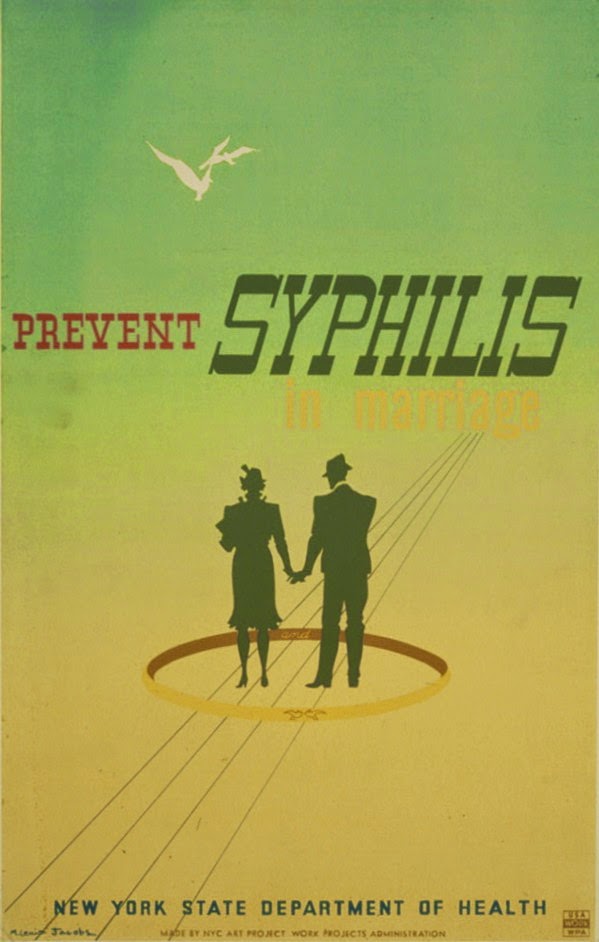
The Reverse New Deal: Giving viruses, bacteria, and cancers a better chance of harming us

(WPA poster, image courtesy of the Library of Congress Prints and Photographs Division.)

One the most consistent--and craziest--things we have had to endure these past few years is all the anti-government spending hysteria emanating, largely, from the political right. Whether it be "sequestration," the 2013 government shutdown, blocked spending bills, or the like, we have watched vital government programs hamstrung by this hysteria.

Ironically, when measured as a percentage of GDP, spending under Obama hasn't been much more (and sometimes less) than during the Reagan years (see chart here). Also, while we're being warned that government spending is out of control, that we need to cut back, and that the world will end if we don't, we have watched many super-wealthy Americans evade & avoid taxes to the tune of hundreds of billions of dollars every single year, we have watched Corporate America amass record profits, we have watched corporate executives rake in more and more bonuses, and we have watched millionaires & billionaires add more millions & billions to their personal fortunes. But remember....."We can't afford it!!!"

(WPA poster, image courtesy of the Library of Congress Prints and Photographs Division.)

During a Senate Committee hearing on September 16, 2014, a National Institutes of Health representative explained the effect of Congress-imposed budget cuts on his agency's ability to respond to disease outbreaks: "it's been a significant impact on us. It has both in an acute and a chronic, insidious way eroded our ability to respond in the way that I and my colleagues would like to see us be able to respond to these emerging threats. And in my institute particularly, that's responsible for responding on the dime to an emerging infectious disease threat, this is particularly damaging." A director for the Centers of Disease Control made a similar statement. (See "Budget Cuts 'Eroded Our Ability to Respond' to Ebola, Says Top Health Official" and also "First diagnosed case of Ebola in the U.S.")

During the 1930s and 40s, New Deal policymakers did a number of things to improve the health of Americans, including enhanced immunizations, mobile health clinics, and hiring unemployed nurses and pharmacists to address the needs of low-income Americans. Today, on the other hand, public health is threatened by constant hysteria over "out-of-control government spending!!" (See also, "Cancer progress threatened by budget cuts in Congress, group says" and "Government shutdown forces clinical trial patients to wait")

 (WPA poster, image courtesy of the Library of Congress Prints and Photographs Division.)

Welcome to the Reverse New Deal.