Monday, September 14, 2015

America's New Deal Navy: Cruisers


Above: The U.S.S. Vincennes (CA-44) in Hawaii, 1942. The Vincennes was one of four cruisers built with PWA funds in the early-mid 1930s. The others were the Savannah, Philadelphia, and Nashville (shown below). The Vincennes served as an escort ship for "Doolittle's Raid" on Japan, participated in the Battle of Midway and also the invasion of Guadalcanal, shot down many Japanese airplanes, and received two battle stars. Unfortunately, she was attacked and sunk by several Japanese ships in August 1942. Photo courtesy of the U.S. Navy, the National Archives, and ibiblio.org.


Above: U.S.S. Savannah (CL-42) and crew, ca. 1942-1945. The Savannah participated in Operation Torch (an allied invasion of axis-controlled North Africa) and supported many troop invasions in the Mediterranean with shore bombardments (knocking out many tanks and artillery batteries). On September 11, 1943, the Savannah was hit with a radio-controlled German glide bomb and lost 197 men. She was repaired but saw no further combat. The Savannah earned three battle stars during World War II. Photo courtesy of U.S. Naval Historical Center and ibiblio.org.


Above: The U.S.S. Philadelphia (CL-41) in New York Harbor, 1943, with a Liberty Ship in the background. The Philadelphia saw heavy combat action in the Mediterranean (for example, shore bombardment and defense against air attacks), in areas such as French Morocco, Sicily, Palermo, and Anzio. This PWA-built cruiser earned five battle stars. Photo courtesy of the U.S. Navy, the National Archives, and ibiblio.org.


Above: On board the U.S.S. Nashville (CL-43), in the South Pacific, 1943. Like the Vincennes, the Nashville provided support for "Doolittle's Raid" on Japan. She also provided convoy, transportation, and shelling support all over the Pacific theater and earned ten battle stars - the most battle stars of all the PWA-built cruisers. Photo courtesy of the Naval Historical Center and ibiblio.org.

Cruisers did it all during World War II. They fought enemy ships, engaged enemy aircraft, participated in shore bombardments, protected other vessels from attack, used their scout planes for reconnaissance missions, and more. The Vincennes was a heavy cruiser "with a standard tonnage of 9,400 and an overall length of 588 feet" and carried "a crew of 551 men." It was armed "with eight 5-inch anti-aircraft batteries...[and] nine 8-inch guns." The Savannah, Philadelphia, and Nashville were light cruisers "with a standard tonnage of 10,000 and overall lengths of 614 feet." They were armed "with eight 5-inch anti-aircraft batteries...[and] fifteen 6-inch guns." All four of these PWA-built cruisers could carry 4 planes and could travel at 32 knots.

Sources of information: (1) Federal Works Agency, Millions for Defense, Washington, DC: U.S. Government Printing Office, 1940. (2) "Executive Order 6174 on Public Works Administration, June 16, 1933," American Presidency Project, University of California - Santa Barbara. (3) Naval History and Heritage Command (http://www.history.navy.mil/).         

Sunday, September 13, 2015

America's New Deal Navy: Gunboats


Above: Of the 32 PWA-funded ships of the early-mid 1930s, two were gunboats - and one of these gunboats was the U.S.S. Erie (PG-50). The Erie evacuated refugees from the Spanish Civil War, served as a training vessel, participated in the re-enactment of "the 1853 friendship visit of Commodore Matthew Perry to Japan" at the U.S. Naval Academy in 1937 (see note 1 below), and rescued about 100 shipwreck survivors during World War II. Unfortunately, the Erie was destroyed by a U-boat torpedo in 1942. Photo of Erie courtesy of Wikipedia.


Above: The second PWA-funded gunboat was the U.S.S. Charleston (PG-51). During World War II, the Charleston participated in the Battle of Attu (U.S. & Canada vs. Japan, on a remote Alaskan island in 1943) and received one battle star. The Charleston became a training ship after the war. Photo of Charleston courtesy of Wikipedia.

Gunboats were "armed with 4 6-inch guns and ten small anti-aircraft guns" and carried "crews of 201 men" (see note 2 below). According to a retired Navy captain, gunboats were "designed like small cruisers. They were built specifically to protect American lives and property in places around the world. They were never intended for major fleet actions and they conducted most of their operations alone" (see note 3 below).

Sources of information: (1) http://usserie.org/. (2) Federal Works Agency, Millions for Defense, Washington, DC: U.S. Government Printing Office, 1940. (3) Captain George Stewart, USN (Retired), "USTS Charleston (PG 51) Massachusetts Maritime Academy Training Ship 1948-1957," Naval Historical Foundation, October 15, 2013. (4) "Executive Order 6174 on Public Works Administration, June 16, 1933," American Presidency Project, University of California - Santa Barbara. (5) Naval History and Heritage Command (http://www.history.navy.mil/).

Saturday, September 12, 2015

America's New Deal Navy: Submarines


Above: New Deal funding in the early-1930s allowed the Navy to build 32 new ships, including four submarines. One of those submarines was the U.S.S Porpoise (P1, SS-172). During World War II, the Porpoise hit or sank 6 Japanese cargo ships, rescued five airmen in the East Indies, served as a training vessel, and earned five battle stars. The photo above shows the Porpoise with a submarine tender in Alaska in the 1930s. The numbers painted on these 4 New Deal-funded submarines seems to have started with P1, P2, P3, and P4, but then changed to 172, 173, 174, and 175 for the war. Photo courtesy of C. Peter Chen and the Naval History and Heritage Command.


Above: New Deal funding built the U.S.S. Pike (P2, SS-173). During World War II, the Pike provided bombing & shelling support, sank a Japanese cargo ship, and received four battle stars. After the war, she served as a training submarine. Photo of Pike courtesy of Wikipedia.  


Above: New Deal funding built the U.S.S. Shark (P3, SS-174). Before World War II, the Shark served as a training vessel and participated in military exercises. The Shark received one battle star during World War II and was probably sunk by a depth charge in Indonesia, in March, 1942 (her fate has never been conclusively determined). Photo of Shark courtesy of the Naval History and Heritage Command.  


Above: New Deal funding built the U.S.S. Tarpon (P4, SS-175). During World War II, the Tarpon sank several Japanese vessels, including a freighter, a passenger-cargo ship, a troop transport, and a patrol ship. The Tarpon also damaged several other Japanese ships and sank the German raider Michel. She received seven battle stars and served as a training submarine after the war. In 1957 she was sunk off Cape Hatteras, North Carolina, perhaps after being used for target practice, and now provides a habitat for a rich variety of marine life (including sharks) as the video above shows. Original YouTube link for video: https://www.youtube.com/watch?v=TCFOGk45Cl8.

The Porpoise-class submarines shown above were described as 300 feet long, 25 foot beam, 14 foot draft, and 1300 tons displacement. They had six 21-inch torpedo tubes, deck guns, mines, 50-men crews, and were powered by diesel-electric engines. They were built at a time when the Navy had little or no money for new construction. The New Deal changed that.  

Sources of information: (1) Naval History and Heritage Command (http://www.history.navy.mil/). (2) "Lay Keel of Submarine Tomorrow," The Portsmouth Herald, October 26, 1933. (3) Rodney K. Watterson, 32 in '44: Building the Portsmouth Submarine Fleet in World War II, Naval Institute Press, 2011. (4) Federal Works Agency, Millions for Defense, Washington, DC: U.S. Government Printing Office, 1940. (5) "Executive Order 6174 on Public Works Administration, June 16, 1933," American Presidency Project, University of California - Santa Barbara.

Friday, September 11, 2015

New Deal Postage Stamps: FDR leads the nation through depression and war


When Franklin Roosevelt was on the campaign trail in 1932, he said: "I pledge you, I pledge myself, to a new deal for the American people. Let us all here assembled constitute ourselves prophets of a new order of competence and of courage. This is more than a political campaign; it is a call to arms. Give me your help, not to win votes alone, but to win in this crusade to restore America to its own people."


In his first inaugural address, in response to the Great Depression, Roosevelt said: "The money changers have fled from their high seats in the temple of our civilization. We may now restore that temple to the ancient truths. The measure of the restoration lies in the extent to which we apply social values more noble than mere monetary profit."  


Like today, many people during Roosevelt's time thought it was wrong for government to help people (even though the Founding Fathers gave the government the right to do so with the General Welfare clause). So, the more Roosevelt tried to help Americans in need, the more they hated him. But Roosevelt stayed true to his beliefs and said: "Better the occasional faults of a government that lives in a spirit of charity than the consistent omissions of a government frozen in the ice of its own indifference" (quote found in the book American-Made, by Nick Taylor, Bantam Books, 2008).


After Germany and Italy declared war on the United States, Roosevelt said: "Rapid and united effort by all of the peoples of the world who are determined to remain free will insure a world victory of the forces of justice and of righteousness over the forces of savagery and of barbarism." The allies won the war three-and-a-half years later.


Less than a year before he died, President Roosevelt signed the G.I. Bill, which offered a range of benefits for World War II veterans. Roosevelt said that the G.I. Bill "gives emphatic notice to the men and women in our armed forces that the American people do not intend to let them down." On the back of the postage stamp pictured above, it reads "...the G.I. Bill helped approximately 2.25 million war veterans attend college. Millions of other GIs received job training; home, business, and farm loans; and unemployment benefits."    


President Franklin Roosevelt died on April 12, 1945, after leading the nation through depression and war, and after setting the nation on course for a vastly improved quality of life - a quality of life that has only recently begun to crumble under the weight of trickle-down economics, tax breaks for the super-wealthy, rampant white collar crime, unrestrained political spending, and naked greed.  In other words, all those things that President Roosevelt and his fellow New Deal policymakers warned us about.

We need another FDR; and we need another, even stronger New Deal.

(All images above from personal collection.)

Thursday, September 10, 2015

New Deal Postage Stamps: Effective & Beneficial Policies


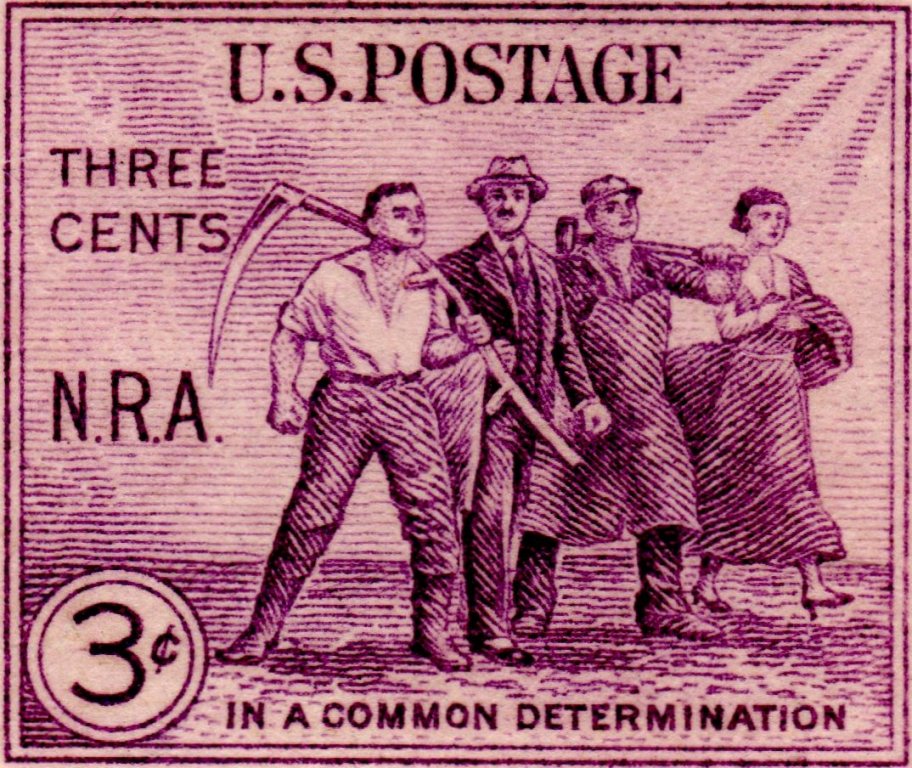
Above: President Roosevelt signed the National Industrial Recovery Act on June 16, 1933. The law created the National Recovery Administration (NRA). The first part of the act sought to regulate competition, but was ruled unconstitutional by the Supreme Court. The second part of the act created the Public Works Administration (PWA). The PWA funded tens of thousands of infrastructure projects across the United States, many of which we still utilize today. Image from personal collection.
        

Above: From 1921 to 1933, there were nearly 15,000 bank failures in the United States. When these banks failed, Americans lost their life savings. The New Deal ushered in bank reforms such as FDIC (bank insurance) and Glass-Steagall (a law regulating the type of money that banks can gamble with). After these reforms, there were less than 600 bank failures between 1934 and 1980 (you can look up bank failure statistics here). Further, "Since the start of FDIC insurance on January 1, 1934, no depositor has lost a single cent of insured funds as a result of a failure." Many conservative politicians, pundits, talk show hosts, and think tank "researchers" believe that the New Deal was a complete failure and are desperately trying to return us to the days of the "Roaring Twenties," where, if your bank fails, tough luck, you lose all your money - even if you had nothing to do with the bank's failure. Isn't that amazing? Image from personal collection.    


Above: Despite the fact that Social Security is arguably the greatest poverty reduction program in human history, many of the conservatives I mentioned in the previous caption want to reduce it, eliminate it, or give it to Wall Street - so their wealthy funders & donors can gamble with it and carve out a nice "management fee" from it. But, considering that corporate executives & investors are actively replacing strong fixed pension plans with anemic 401k's, and letting wages stagnate for millions of American workers, and engaging in all manner of civil & criminal wrongdoing, do you really trust them with your retirement security? President Roosevelt and his fellow New Deal policymakers created Social Security because of the malignant, selfish, and incompetent behavior of many of those who work on Wall Street. To now let those type of people steal from "manage" Social Security would be the height of irresponsibility - and, if it happens, we will suffer dearly for it. Image from personal collection.

Wednesday, September 9, 2015

New Deal Postage Stamps: FDR's Four Freedoms


Above: On January 6, 1941, President Roosevelt gave a State of the Union speech that is now known as the Four Freedoms Speech. In addition to outlining four essential freedoms for all people (detailed below), Roosevelt also said "there is nothing mysterious about the foundations of a healthy and strong democracy. The basic things expected by our people of their political and economic systems are simple. They are: Equality of opportunity for youth and for others. Jobs for those who can work. Security for those who need it. The ending of special privilege for the few. The preservation of civil liberties for all. The enjoyment of the fruits of scientific progress in a wider and constantly rising standard of living." Image from personal collection.


Above: "In the future days, which we seek to make secure, we look forward to a world founded upon four essential human freedoms. The first is freedom of speech and expression - everywhere in the world." - FDR. Image from personal collection.


Above: "The second is freedom of every person to worship God in his own way - everywhere in the world." - FDR. Image from personal collection.


Above: "The third is freedom from want - which, translated into world terms, means economic understandings which will secure to every nation a healthy peacetime life for its inhabitants - everywhere in the world." - FDR. Image from personal collection.


Above: "The fourth is freedom from fear—which, translated into world terms, means a world-wide reduction of armaments to such a point and in such a thorough fashion that no nation will be in a position to commit an act of physical aggression against any neighbor—anywhere in the world." - FDR. Image from personal collection.

Roosevelt said that his four proposed freedoms were "no vision of a distant millennium," but "a definite basis for a kind of world attainable in our own time and generation." On this point he was wrong of course. Even the 60 million or more deaths of World War II could not ensure a world with these four basic freedoms. In the United States, for example, conservative politicians have fought tooth and nail to deny the expansion of affordable health insurance to low-income citizens, thereby prolonging want. Still, Roosevelt's Four Freedoms could be part of a larger, more comprehensive movement in the future - when humanity is ready to put aside anger, hatred, greed, and insinuations of laziness towards anyone who isn't rich. 

"Freedom means the supremacy of human rights everywhere."
--FDR

Tuesday, September 8, 2015

New Deal Postage Stamps: FDR the Stamp Collector


Above: According to one stamp collector's well-documented blog, this 1950 stamp commemorates "the 25th anniversary of the Asociacion Filatelic de Philipinas, the oldest philatelic society in the Philippines. U.S. President Roosevelt, an honorary member prior to his death, is portrayed  enjoying his stamp collection." Image from personal collection.


Above: This 1936 photo shows President Roosevelt examining his stamp collection. Photo courtesy of the Library of Congress.