Friday, April 14, 2017

New Deal Art: "Summer Pastures"

Above: "Summer Pastures," an oil painting by Dorothy Varian (1895-1985), created while she was in the New Deal's Public Works of Art Project, 1934. Varian had a prolific art career. In 1968 it was reported that she had "received high praise as a colorist, and working with color is her first interest. Critics have lauded her work in oil as subtle and often shimmery - oriental in its serenity and based on simplicity" ("Splash of Color at Polari," The Kingston Daily Freemen, July 27, 1968, p. 26). The "serenity" and "simplicity" of "Summer Pastures" offers a nice respite from today's perpetual bad news. Image courtesy of the Smithsonian American Art Museum.

Wednesday, April 12, 2017

New Deal Mattresses, Sheets, Pillow Cases, Quilts, and Comforters

Above: At this WPA mattress-making project in Savannah Georgia, April 1936, workers are removing small sticks and debris from Spanish moss collected from oak trees. Photo courtesy of the National Archives.

Above: After being steamed for two hours, the moss is hung out to dry. Photo courtesy of the National Archives.

Above: A mattress is nearing completion after being filled with the Spanish moss. Photo courtesy of the National Archives.

Above: After a long day of making mattresses for low-income families, the WPA workers enjoy their dinner. Photo courtesy of the National Archives.

Above: WPA workers stuffing mattresses in Topeka, Kansas, ca. 1935-1943. Photo courtesy of the National Archives and the New Deal Network.

Above: These WPA workers in Waco, Texas are tufting newly-made mattresses, ca. 1935-1943. Photo courtesy of the National Archives and the New Deal Network.

During the New Deal, relief workers made millions of bedding items for low-income Americans struggling through the Great Depression. For example, from 1934 to 1935, workers in the Federal Emergency Relief Administration (FERA) produced 1.3 million mattresses, 3.1 million quilts & comforters, 4 million sheets, and 5.3 million pillow cases (The Emergency Work Relief Program of the FERA, April 1, 1934 - July 1, 1935, 1935, p. 65).

Sometimes, New Deal bedding items helped after natural disasters. For example, on April 28, 1942, it was reported that WPA workers responded to a devastating tornado in Pryor, Oklahoma with "500 mattresses, 1,000 blankets, 2,000 sheets, 500 pillows and towels and more than $1,000 in food [about $15,000 in today's dollars]" ("State Disaster Relief Speeded," Miami DailyNews-Record).

Monday, April 10, 2017

New Deal Art: On the rails

Above: "Pacific Cable Car - San Francisco," a lithograph by Marguerite Redman Dorgeloh (1890-1944), created while she was in the WPA's art program, ca. 1935-1943. Image courtesy of the Smithsonian American Art Museum.

Above: "The Railroads Came To Town," a watercolor by Saul Berman (1899-1975), created while he was in the WPA's art program, ca. 1935-1943. Image courtesy of the Smithsonian American Art Museum.

Above: "Bridges in Winter," an oil painting by Nicola Victor Ziroli (1908-1970), created while he was in the New Deal's Public Works of Art Project, 1934. Image courtesy of the Smithsonian American Art Museum.

Above: "Subway," an oil painting by Lily Furedi (1896-1969), created while she was in the New Deal's Public Works of Art Project, 1934. Image courtesy of the Smithsonian American Art Museum.

Above: A model of "The Montezuma," the first mountain locomotive of the Denver and Rio Grande Railroad. The model was created by WPA workers for the Colorado State Museum, ca. 1935-1943. Photo courtesy of the National Archives.

Above: "6th Avenue Subway," an aquatint on paper by Harry Francis Mack (1907-?), created while he was in the WPA's Federal Art Project, ca. 1935-1939. Image courtesy of the Smithsonian American Art Museum.

Above: "Uptown," a color lithograph by Leonard Pytlak (1910-1998), created while he was in the WPA's art program, ca. 1939. Image courtesy of the Smithsonian American Art Museum.

Above: "Arrival of First Train in Herrington," a mural study for the Herrington Post Office [Kansas], created by Harry Louis Freund (1905-1999), created while he was working for the New Deal's Section of Fine Arts (Federal Works Agency, Public Buildings Administration), ca. 1939-1943. Image courtesy of the Smithsonian American Art Museum.

Above: "Engine House and Bunkers," an oil painting by Austin Mecklem (1894-1951), created while he was in the New Deal's Public Works of Art Project, 1934. Image courtesy of the Smithsonian American Art Museum.

Above: "Along the River," an oil painting by Lamar Dodd (1909-1996), created while he was in the New Deal's Public Works of Art Project, 1934. Image courtesy of the Smithsonian American Art Museum.

Above: "Back o' the Yards #3," a gouache painting by Mitchell Siporin (1910-1976), created while he was in the WPA's Federal Art Project, 1937. Image courtesy of the Smithsonian American Art Museum.

Above: "Engines and Landscape," a watercolor by Nelson Rosenberg (1908-1988), created while he was in the WPA's Federal Art Project, 1936. Image courtesy of the Smithsonian American Art Museum.

Above: "Modern Music," a linoleum cut on paper by Albert Potter (1903-1937), created while he was in one of the New Deal art programs, ca. 1933-1936. Image courtesy of the Smithsonian American Art Museum.

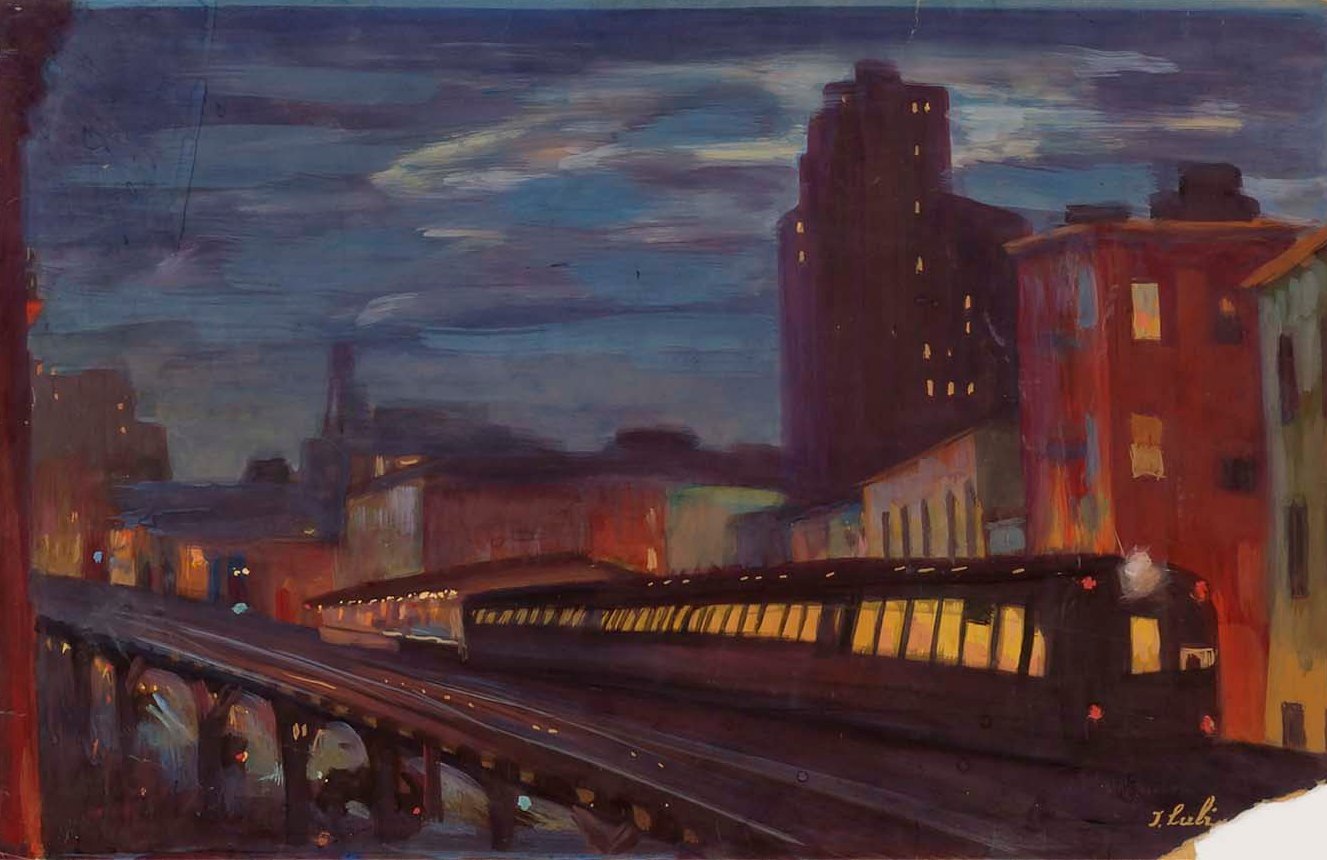
Above: "Nocturne," a tempera on paperboard by Jack Lubin (1907-1986), created while he was in the WPA's Federal Art Project, 1938. Image courtesy of the Smithsonian American Art Museum.

 Above: Part of the mural, "The History of Transportation," at the Towson Post Office [Maryland], created by Nicolai Cikovsky, while he was on commission with the New Deal's Treasury Section of Fine Arts, 1939. Photo by Brent McKee, used here for educational, non-commercial purposes.

Above: "Railroading," a mural study by Arthur Herschel Lidov (1917-1990), created while he was in one of the New Deal art programs; probably the Public Building Administration's Section of Fine Arts, ca. 1941. Image courtesy of the Smithsonian American Art Museum.

Saturday, April 8, 2017

New Deal Funds Moved America

By Streetcar...

Above: Citizens of Indianapolis, Indiana wait for their streetcar, ca. 1938. Around this time, the following was reported: "Co-operation of it's 1,000 employees, the citizens of Indianapolis and the Public Works Administration has enabled the Indianapolis Railways, Inc., to give the city one of the best streetcar transportation systems in the country" ("President of Local Streetcar System Attributes Success to Co-Operation," The Indianapolis Star, September 14, 1938). Photo courtesy of the National Archives.

By Bus...

Above: The description for this photograph, taken ca. 1938, reads, "A battery of buses ready for service - PWA funds provided this public utility service." This was part of a massive public transportation initiative in Indianapolis ("World Watches Improvement of Local Company: Ten-year rehabilitation project for system is finished 4 years ahead of schedule with expenditure $1,000,000 below estimate... 323 modern cars, trolleys, and buses purchased - public patronage increases," The Indianapolis Star, July 17, 1938). Photo courtesy of the National Archives.

By subway...

Above: The description for this photograph, taken ca. 1936-1939, reads, "Eight Avenue express leaves the Hoyt Street station in New York's modern subway - constructed by PWA." Photo courtesy of the National Archives.

By Sea...

Above: "Huge ocean liners dwarf enormous docks at New York City - [docks] constructed by PWA." Photo taken ca. 1935-1939, provided courtesy of the National Archives.

By Air...

Above: An airplane at Baltimore Municipal Airport, 1941. The airport was one of 900 built or improved by the WPA. Photo courtesy of the University of Maryland College Park Archives.

By Car...

Above: "The new Kanawha River Boulevard [West Virginia], constructed with PWA funds." Between 1933 and 1943, well over a million miles of roads were built or improved by various New Deal work programs. Photo taken in July 1940, provided courtesy of the National Archives.

By Train...

Above: The New Deal provided funds for new trains, like "The Comet," and also for new and improved tracks. Photo courtesy of the National Archives.

In his 2015 book, Great Again: How To Fix Our Crippled America, Donald Trump wrote: "If we do what we have to do correctly, we can create the biggest economic boom in this country since the New Deal when our vast infrastructure was first put into place..." Unfortunately, the Trump Administration is turning its back on that statement. For example, they are proposing to cut funding for rural infrastructure, cut funding for Amtrak, and sell off public infrastructure to greedy and careless private investors. This is the exact opposite of the New Deal's approach to infrastructure - an approach which provided federal funds, and federally-paid labor, to build and modernize hundreds of thousands of infrastructure systems all across the nation: roads, sidewalks, tunnels, dams, bridges, airports, piers & docks, trains, buses, water mains, reservoirs, sewer lines, utility plants, parks, and more. 

New Deal policymakers understood that infrastructure is a common good and should be controlled by "we the people," not big financial institutions. Donald Trump seems to have understood this too, just as he also understood how single-payer health care is superior to the mess of a health care system that we have now. For some reason, he has abandoned these positions and caved to right-wing extremists who fervently believe that billionaires, i.e., the holy "JOB CREATORS" (who love shipping our jobs overseas) should be in control of every aspect of our lives. This doesn't bode well for our infrastructure.

Thursday, April 6, 2017

Roosevelt's Wheelbarrow Army

Above: "Wheelbarrow," an oil painting by Morris Graves (1910-2001), created while he was in the New Deal's Public Works of Art Project, 1934. Image courtesy of the Smithsonian American Art Museum.

Above: A procession of WPA workers, with their wheelbarrows, on the Arkansas River in Wichita, Kansas, 1936. Photo courtesy of the National Archives.

Above: The Wichita men are working on a flood control project. Photo courtesy of the National Archives.

Above: Millions of men lost their livelihoods during the Great Depression, and millions more insulted them for it. The same thing happened during the most recent recession, and the same thing will happen again when machines start replacing more and more workers in the near future (for example, think about driverless cars, trucks, and 18-wheelers). It's a timeless story: the rich get richer, through some innovation or swindle, and then the millions who lose their jobs are lectured about "personal responsibility." Aubrey Williams, a top administrator in the New Deal work-relief programs, once wrote: "To fill his bitter cup to overflowing, he has been ridiculed by thoughtless and cruel people as a loafer... But his day is coming... when all the barbs that have been hurled at him bounce back from the good, honest masonry of the things he has built to increase the wealth and happiness of the whole nation" (New York Times, May 10, 1937). Photo courtesy of the National Archives.

Above: As one group unloads their wheelbarrows, another group waits to fortify the embankment. Look at the man leaning on his shovel. This reminds me of how WPA workers were frequently called "shovel-leaners" - a derisive comment that was intended to persuade Americans that WPA workers were just lazy good-for-nothings, and thus wasting taxpayer money. But anyone who has done hard physical labor knows that you have to rest from time to time. Our bodies are not designed to work non-stop like tractors. Author John Steinbeck once observed that "it was the fixation of businessmen that the WPA did nothing but lean on shovels. I had an uncle who was particularly irritated at shovel-leaning. When he pooh-poohed my contention that shovel-leaning was necessary, I bet him five dollars, which I didn't have, that he couldn't shovel sand for fifteen timed minutes without stopping. He said a man should give a good day's work and grabbed a shovel. At the end of three minutes his face was red, at six he was staggering and before eight minutes were up his wife stopped him to save him from apoplexy. And he never mentioned shovel leaning again" ("A Primer on the '30s," Esquire, June 1960). Photo courtesy of the National Archives.

Above: Roosevelt's Wheelbarrow Army in Wichita heads back for another load of Earth. Photo courtesy of the National Archives.

Wednesday, April 5, 2017

WPA School Patrol

Above: A WPA crossing guard for schoolchildren in Indianapolis, Indiana, ca. 1935-1943. Photo courtesy of the National Archives.

Sunday, April 2, 2017

New Deal Art: "Competition"... and how the New Deal fed a hungry nation

Above: "Competition," a woodcut by Harry Rein (1908-1969). According to the Baltimore Museum of Art, Rein made this woodcut when he was in the WPA's Federal Art Project, ca. 1935-1939. The woodcut depicts hungry children competing with dogs for scrap food in trash cans. It highlights some of the awful conditions that existed after reckless banking and insatiable greed blew the American economy apart in 1929. Image courtesy of the Smithsonian American Art Museum.

Above: A WPA-provided meal in Jacksonville, Florida, ca. 1935-1943. The WPA provided over 1.2 billion school lunches to hungry children, and also had a summer lunch program (Federal Works Agency, Final Report on the WPA Program, 1935-43, 1946, pp. 68 and 134). Photo courtesy of the National Archives.

Above: Ellen Woodward (right), head of the WPA Womens' and Professional Division, visits a surplus commodities distribution center in Washington, DC, ca. 1936. The New Deal's Federal Surplus Commodities Corporation (FSCC) distributed food all across the country to people in need. In 1936, for example, the FSCC in Colorado distributed 80,000 pounds of dry milk, 990,000 pounds of apples, 1,000 crates of cauliflower, and more (FSCC annual report for 1936, p. 11). Photo courtesy of the National Archives.

Above: The food stamp program (today, called the Supplemental Nutrition Assistance Program, or "SNAP") had its genesis in the New Deal's "Food Stamp Plan." This plan, administered by the New Deal's Federal Surplus Commodities Corporation (note the "F.S.C.C." in the upper left-hand corner of the stamps) allowed a person on relief to buy orange stamps, and then receive the blue stamps for free to purchase additional food. Image from personal collection.

Above: These WPA workers are enjoying a meal on a boat in the Delta National Wildlife Refuge, ca. 1937. The men lived on these boats while they were creating the refuge (today, the refuge is used for hunting, fishing, wildlife viewing, and boating). When the private sector rejected millions of working class Americans during the Great Depression, the WPA gave them jobs and hope. We still benefit from thousands of WPA projects today, 80 years later. Photo courtesy of the National Archives and the New Deal Network.

Above: The WPA restored dignity to millions of unemployed Americans--Americans who had been spit out by the private sector and insulted by their fellow citizens--by providing them with meaningful jobs and the ability to support their families through difficult times. This father, a WPA worker, is having dinner with his family in Zeigler, Illinois, 1939. One survivor of the Great Depression recalled, "my father immediately got employed by this WPA. This was a godsend. This was the greatest thing. It meant food, you know. Survival, just survival" (Studs Terkel, Hard Times: An Oral History of the Great Depression, 1986 reprint, p. 86). Some people thought that WPA jobs were useless made-work, and that WPA workers were lazy good-for-nothings. This type of mentality is still prevalent today, with right-wing politicians, talking heads, and Internet-commenters calling the poor & unemployed all manner of foul names, and likening them to animals. But even the founder of the modern right-wing movement knew better. In his autobiography, Ronald Reagan wrote: "The WPA was one of the most productive elements of FDR's alphabet soup of agencies because it put people to work building roads, bridges, and other projects... it gave men and women a chance to make some money along with the satisfaction of knowing they earned it" (An American Life, p. 69). Photo courtesy of the Library of Congress.