Thursday, June 30, 2022

The New Deal built and improved American Indian schools. Today, we're letting them crumble.


Above: Very early on in the New Deal, funds started flowing towards American Indian infrastructure needs, for example, schools. The text above is part of a longer article from the newsletter Indians at Work, U.S. Office of Indian Affairs, November 15, 1933, pp. 32-33. Notice that the article highlights how New Deal / PWA-funded schools would be moving away from the infamous boarding schools. 

Above: The WPA also assisted, building, improving, expanding, and repairing many American Indian schools. This is part of a longer article from the Sioux City Journal (Sioux City, Iowa), July 30, 1939, p. 18. Image from newspapers.com, used here for educational and non-commercial purposes.

A New Deal break in the inaction

In a Huffington Post article today, about crumbling American Indian schools, Congresswoman Melanie Stansbury (D-N.M.) stated, "We are trying to bring systematic change to the system that will impact the lives of hundreds of thousands of Native children. We can push Congress and we can push the administration to make these investments because that's how you move the system after hundreds of years of inaction."  

Stansbury's sentiments are 100% spot-on. But her statement could use an additional sentence: "The New Deal was a break from that inaction, and we should have another New Deal for American Indian schools."

The Huffington Post article reports, "The appalling conditions faced by tribal schools and the children inside of them are a result of the U.S. government's failure to uphold its treaty obligations to Native American tribes, who gave up large swaths of land in exchange for the federal government guaranteeing investments in tribal communities to provide for their education and well-being. Congress has never provided sufficient funding for tribal schools, and their infrastructure shows it."

Again, we need a slight adjustment here. The New Deal Congress began to provide sufficient funding and attention for American Indian concerns, through the CCC, PWA, WPA, Indian Reorganization Act, Indian Arts and Crafts Board, and other programs. But, as in so many other instances, subsequent generations of Americans backslid into the same tired routine of inaction, neglect, and laziness. They stopped having concern for their American Indian fellow citizens. They dropped the New Deal baton that was handed to them.

In the modern era, Americans have decided that it is more important that Jeff Bezos and Elon Musk have enough money to build a private set of spaceships--so the super-rich can experience the ultimate thrill ride--than it is for Congress to provide sufficient funding for American Indian schools. It's a sick, demented set of priorities - but perhaps the inevitable outcome of a plutocracy populated by apathetic,  misinformed, and in some cases, bigoted citizens.

(Also see, "Baltimore City Schools Without Air Conditioning Will Release Early Thursday," CBS Baltimore, June 2, 2022, and ask yourself: "How is it that, in the 21st century, so many K-12 schools don't have air conditioning - 120 years after the invention of air conditioning?)

Sunday, June 26, 2022

FDR delivered us privacy. Republicans want to take it away, and then leer into our bedrooms.

Busybody: "A person who pries into or meddles in the affairs of others." (Dictionary.com)


Above: "Private Road," an oil painting by George Henry Melcher (1881-1957), created while he was in the WPA, 1939. People need some degree of privacy; a place or mental state free from obnoxious busybodies. Image courtesy of the General Services Administration and the Long Beach Museum of Art.


Above: The description for this photograph reads, "Named to Supreme Court. Washington, D.C., March 20 [1939]. William O. Douglas... was today nominated to the Supreme Court Bench by President Roosevelt. This picture of Douglas... was made today shortly after the announcement from the White House." Douglas would serve on the Court from 1939-1975. Photo by Harris & Ewing, courtesy of the Library of Congress.


Above: Douglas was a committed New Dealer and, over time, became increasingly interested in protecting civil liberties. Photo from The Bangor Daily News (Bangor, Maine), January 1, 1938, from newspapers.com, and used here for educational and non-commercial purposes.

FDR, William Douglas, and Privacy

FDR put William Douglas on the Supreme Court in 1939. And, like many other judicial instances, FDR's appointment led to increased equality and personal freedom. In Griswold v. Connecticut (381 U.S. 479, 1965), the Supreme Court held that married people have the right to learn about and use contraception.

In the majority opinion, Douglas asked, "Would we allow the police to search the sacred precincts of marital bedrooms for telltale signs of the use of contraceptives? The very idea is repulsive to the notions of privacy surrounding the marriage relationship. We deal with a right of privacy older than the Bill of Rights older than our political parties, older than our school system."

And yet, here we are, well into the 21st century, and our Republican Supreme Court does indeed want the government to police our bedrooms. Republicans want to know: "Who are you married to? What are you doing in your bedroom? Did you put a condom on? I don't think I like that. Are you taking birth control? Let me see it - I need to see it. What kind of sex are you having? I need to know. Maybe I'll watch you two, to make sure you're not doing things I wouldn't do. Are you pregnant?? Oh wonderful, I now appoint myself as your family manager. You can email me your weekly reports."

In the recent abortion case, the Republican Justice Clarence Thomas expressly stated that it's time to overturn the Griswold ruling. However, Republican Justice Brett Kavanaugh tried to calm things down by writing, "First is the question of how this decision will affect other precedents involving issues such as contraception and marriage - in particular, the decisions in Griswold v. Connecticut, 381 U. S. 479 (1965)... I emphasize what the Court today states: Overruling Roe does not mean the overruling of those precedents, and does not threaten or cast doubt on those precedents."

Nonsense. Some (if not all) of the Republican justices lied to get on the Court. They led Senators to believe that they would not overturn Roe, and then they did just that, without hesitation. Now they're telling us, "Hey, don't worry, we won't go any further. Trust us." Do you believe them? If so, the justices are also selling the Brooklyn Bridge. Maybe you can buy that too.

What Kavanaugh and the others are likely doing is playing the long game - waiting until the furor of the recent decision dies down. Next, they will remove protections for same-sex marriage. Then for sex acts that can't result in pregnancy, for example, using contraceptives. You see, even something as simple as a condom sometimes had to be sold "under the counter" back in the day, lest the busybodies see you and call the police (see, "The Birth Control Controversy in Connecticut" eCommons, University of Dayton School of Law). 

And over the long-term, as Americans keep electing Republicans--in the name of "limited government"--our freedom and quality of life will continue to deteriorate. "Inter-racial marriages?? That's not in the Constitution. Stop it! Integrated schools?? Where does it say that? Go back to your colored schools! Social Security?? No, no, no... the general welfare means nothing, if it means anything. Back to the work houses and poor houses, you oldies!"

Make no mistake about it: A vote for a Republican (or not voting at all) is a self-destructive act against your privacy. You're inviting the government into your bedroom, to leer at you and take notes.

And it will be interesting to see, during the midterms, how many people are willing to give up their right to privacy, in the hopes of saving a few bucks at the gas pump, or to carry a pistol around like Wyatt Earp, or to "own the libs."

"I prefer and I am sure you prefer that broader definition of liberty under which we are moving forward to greater freedom, to greater security for the average man than he has ever known before in the history of America."

--President Franklin Roosevelt, "Fireside Chat," September 30, 1934.

Saturday, June 18, 2022

Thousands of CWA trees for Berkeley, California


Above: Part of an article from The San Francisco Examiner, February 23, 1934, p. 2. The article reports that 8,500 trees had already been planted in Berkeley, California, by Civil Works Administration (CWA) workers, and that requests for more trees were coming in "from all parts of the city." How many of these New Deal trees might still exist today? Image from newspapers.com, used here for educational and non-commercial purposes.

Thursday, June 9, 2022

CCC Company 556 (Indiana) at ages 4, 29, 49, and 88. "It was the first time in my life I had enough to eat."

CCC Company 556, Camp SP-7, Pokagon State Park, Indiana...

At age 4 (1938):


Above: From the Steuben Republican (Angola, Indiana), April 6, 1938, p. 2. Note that the advertisement is about the 5th anniversary of the CCC. However, Company 556 was formed in July 1934, and thus one year younger. Image from newspapers.com, used here for educational and non-commercial purposes.

At age 29 (1963):


Above: A 1963 CCC reunion at Pokagon State Park. Photo by Field Enterprises, Inc., scanned from personal copy, and used here for educational and non-commercial purposes.

At Age 49 (1983):


Above: Part of an Associated Press article about the 1983 reunion of Company 556, in The South Bend Tribune (South Bend, Indiana), July 21, 1983, p. 29. In the article, a veteran of the company, James Sendo, says he "had nowhere to go. No family, home, job... The CCC was my answer... It was the first time in my life I had enough to eat... The CCC enabled me to begin my dream of an education." After the CCC, Sendo served in the Army during World War II, earned a Ph.D. at Michigan State University, and taught at Western Michigan University. Image above from newspapers.com, used here for educational and non-commercial purposes.

At age 88 (2022):


Above: A screen grab from the website of the Indiana Department of Natural Resources, advertising the 69th annual reunion of CCC Company 556 on July 31, 2022.

The CCC in Indiana

The work of the CCC in Indiana included: 596 bridges (vehicle bridges, foot bridges); 416,000 check dams for soil erosion control: and reforestation of over 23,000 acres. They also, of course, fought wildfires. In 1933, for example, the CCC helped save Clark State Forest, near Henryville: "Without the help of the civilian conservation corps the state forest would have suffered heavy damage" ("CCC Workers Stop Fire Near Forest Reserve," The Indianapolis Star, December 3, 1933, p. 7).

Wednesday, June 8, 2022

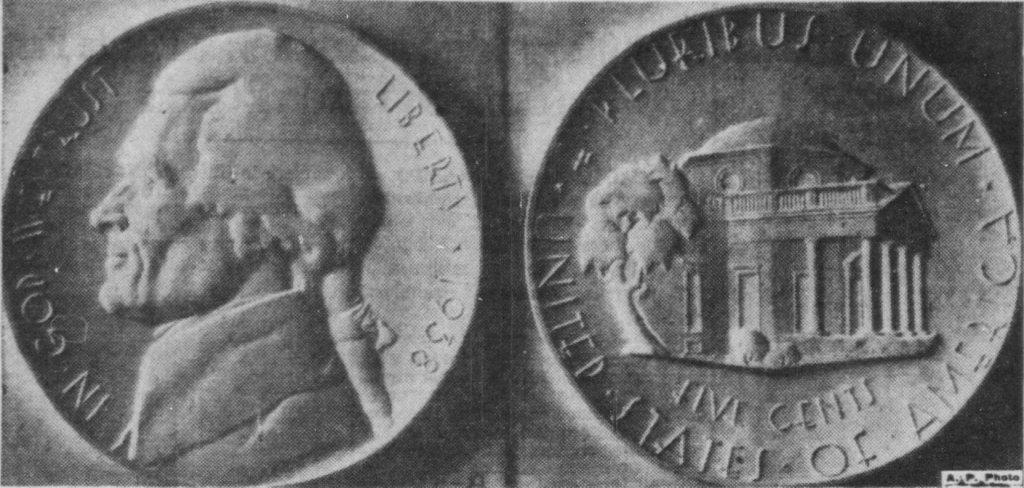
The most prolific of New Deal art: The Jefferson Nickel


Above: The Jefferson Nickel was designed by Felix Schlag in 1938, and was the result of a competition by the New Deal's Treasury Section of Painting & Sculpture. The image above, featuring photos from the Associated Press and Harris & Ewing, comes from the Evening Star (Washington, DC), April 22, 1938, p. A-9, courtesy of the Library of Congress, and used here for educational and non-commercial purposes.


Above: Felix Schlag's winning design. The Jefferson Nickel replaced the Buffalo, or Indian- Head nickel. Associated Press photo, in the Boston Globe, 4-22-1938, newspapers.com, used here for educational and non-commercial purposes.


Above: A closer view of the reverse side of Schlag's winning design, from the previous photo.


Above: Schlag worked with the U.S. Mint to create the final nickel design. From 1938 to 2004, tens of billions of the Schlag-designed Jefferson nickels were minted. Starting in 1966, the initials "FS" (Felix Schlag) were added to the nickel. Image from the Annual Report of the Director of the Mint, fiscal year 1939.


Above: Nellie Tayloe Ross, director of the U.S. Mint, and Edward Bruce, Treasury art official, inspect the many competition designs for the new Jefferson nickel, Washington, DC, April 20, 1938. Photo by Harris & Ewing, courtesy of the Library of Congress.

Tuesday, May 31, 2022

Meet the Three C's of Glendora, California: Camp Dalton Canyon

 Unless otherwise noted, all photos are from: Civilian Conservation Corps, Official Annual, 1938, Los Angeles District, Ninth Corps Area, Baton Rouge, LA: Direct Advertising Co., 1938 (used here for educational and non-commercial purposes).


Above: Part of CCC Company 1946, "Camp Dalton Canyon." These men worked in the Angeles National Forest area, on the north side of Los Angeles and Glendora, California.


Above: A closer view of some of the young men in Company 1946.


Above: Camp Dalton Canyon responded to many forest fires. The driver of this truck might be Jake Lupin (more on Lupin below).


Above: The kitchen staff of Camp Dalton Canyon. For many young enrollees, the three square meals offered by the CCC were the best eating they ever had.


Above: Here are members of Camp Dalton Canyon in journalism class.


Above: The hospital at Camp Dalton Canyon. The CCC offered good healthcare. 


Above: Radio training at Camp Dalton Canyon.


Above: The library at Camp Dalton Canyon.


Above: One of the major projects of the CCC enrollees at Camp Dalton Canyon was the development of a science station at Tanbark Flats, in the San Dimas Experimental Forst (which is inside the larger, Angeles National Forest). The 1938 CCC Annual for the Los Angeles District explains that Camp Dalton Canyon had various projects in the experimental forest, "including construction of 76 lycimeters, which are concrete experimental tanks unique in the Forest Service, by which experts may tabulate erosion and climate data by observation of different natural chaparral." The science station is still used today. The photo above was taken by a Los Angeles Times photographer, from the article, "Six Experimental Dams Rise in Rainfall Study," August 13, 1933, newspapers.com, used here for educational and non-commercial purposes.


Above: The man on the upper right is Jacob Lupin, or "Jake" (1919-1938). And the man on the lower left is his brother Joe (1917-1968). Jake died in March 1938 (not long after this photo was published), while on a CCC mission to save people during a flood disaster. See Jake's Find-a-Grave page and photo here.


Above: Part of an article about Jake Lupin's death, from The Redondo Reflex (Redondo, California), March 11, 1938, p. 1. Image from newspapers.com, used here for educational and non-commercial purposes.


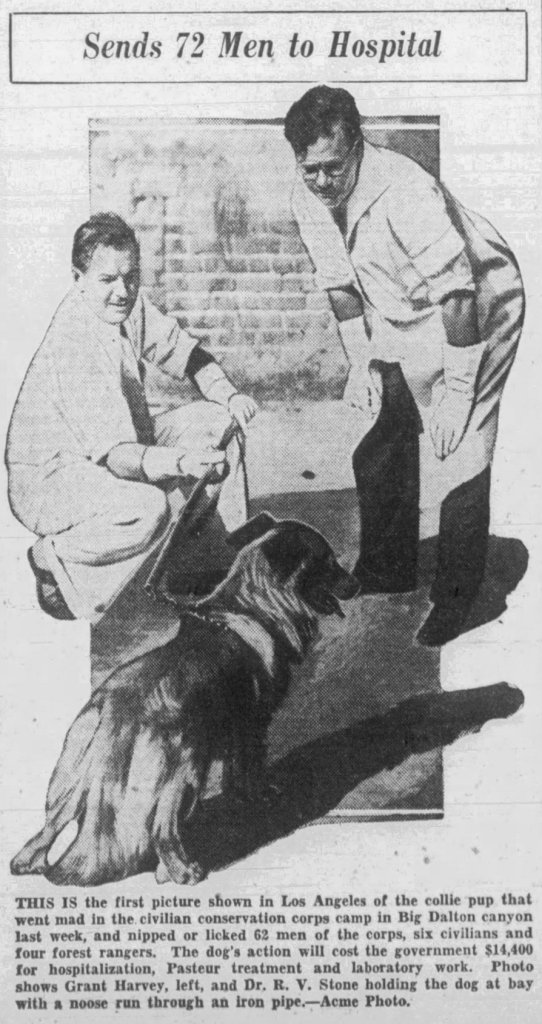
Above: Jake Lupin's death highlights how life in the CCC could be quite dangerous at times. Another enrollee at Camp Dalton Canyon, 19-year-old David Meredith, died when he was called to a forest fire and the truck he was riding in overturned ("CCC Youth Killed," The Pomona Progress Bulletin (Pomona, California), October 25, 1937). The article above--from the Illustrated Daily News (Los Angeles), August 17, 1933--notes dozens of Camp Dalton Canyon men being bitten or licked by a rabid dog. Other dangers faced by the CCC included snakes, falling trees, and steep or high work areas. Image above from newspapers.com, used here for educational and non-commercial purposes.

Wednesday, May 25, 2022

Helen Tamiris and the WPA Dance Theatre Strike - 85 years ago this month


Above: This photo was taken on May 19, 1937, and shows picketers outside the Nora Bayes Theatre, New York City. They are protesting cuts to WPA funding. Unknown photographer, used here for educational and non-commercial purposes.

"People Need Art, Artists Need Jobs"

After the May 19, 1937 performances of How Long Brethren? and Candide, at the Nora Bayes Theatre in New York City (both WPA, Federal Theatre productions), performers Helen Tamiris and Charles Weidman asked the crowd to participate in a sit-down strike. Tamiris and Weidman--and millions of others across the country--were angry that WPA funding was about to be cut. The audience, and about 30 cast members, stayed inside the theatre until at least 3 a.m.

Meanwhile, "Hundreds of pickets arrived outside the building from other directions almost simultaneously with the strike announcement, many of them carrying banners such as 'The WPA Must Go On,' 'There Shall Not Be More Layoffs,' and 'Keep Us Out Of the Breadline'" ("Sit-Down Strike Called At A WPA Theatre In N.Y.," Standard-Sentinel (Hazleton, Pennsylvania), May 20, 1937, p. 1). Emergency police squads were called to the scene to keep the peace.

(If you look VERY closely at the photo above, you'll see a sign that says, "People Need Art, Artists Need Jobs.")

Unfortunately, the strike was for naught (other than expressing displeasure); the WPA cuts were enacted; the so-called Roosevelt Recession ensued; then WPA funds were restored; and the economy sprung to life again (turns out... in a consumer-driven economy... consumers need money! - oh well, who could've known??).

Above: A poster advertising How Long Brethren? and Candide at the Nora Bayes Theatre. Note that Helen Tamiris choreographed and directed How Long Brethren? and Charles Weidman choreographed and directed Candide. Image courtesy of the Library of Congress.


Above: Helen Tamiris, ca. early 1930s. Tamiris was a pioneer of Modern Dance, and a leader in the Federal Dance Project (see the Living New Deal's biography of Helen Tamiris and summary of the Federal Dance Project). Unknown photographer, used here for educational and non-commercial purposes.


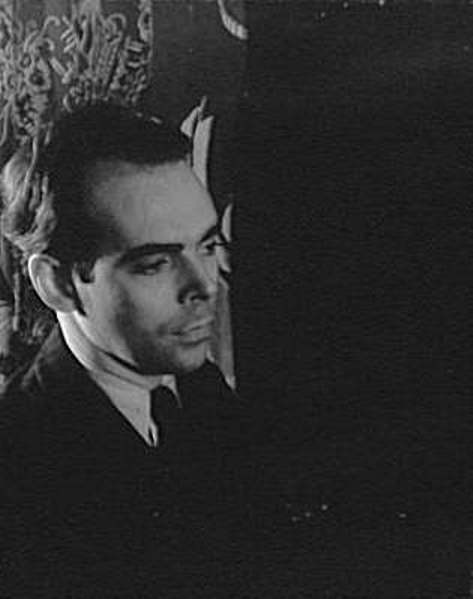
Above: Charles Weidman helped Tamiris lead the strike. Weidman was also a pioneer of the Modern Dance movement. Photo courtesy of Wikipedia.