Above: The "Processional" was a play written by John Howard Lawson, ca. 1924-1925, and was performed by WPA actors in 1937. Lawson was a member of the "Hollywood Ten," a group of men sent to prison in 1950 for failing to give information to a witch hunting Congressional committee. The men refused to answer questions about their possible communist affiliation and, after serving their prison sentences, were largely blacklisted from Hollywood. WPA poster, courtesy of the Library of Congress Prints and Photographs Division.
Periodic posts about the most interesting time in American history: The New Deal!
Tuesday, March 31, 2015
Monday, March 30, 2015
A New Deal for West Virginia
(Eleanor Roosevelt speaks at a 2013 New Deal Festival in Arthurdale, West Virginia, while FDR surveys the crowd. Photo by Brent McKee.)
A few months ago, Slate staff writer Betsy Woodruff reported that West Virginia, before turning Republican, had a "deep-seated, long-lasting loyalty to the party of FDR...Eleanor Roosevelt also won affection for helping start Arthurdale, a planned community for economically disadvantaged West Virginians."
West Virginia had good reason to appreciate its New Deal legacy. Here are some interesting New Deal facts & figures for the Mountain State...
Civil Works Administration (CWA):
In January of 1934, there were 85,000 West Virginians working in the CWA, building or repairing schools, roads, bridges, and more.
(Source: "Analysis of Civil Works Program Statistics," 1939, p. 18)
Civilian Conservation Corps (CCC):
Between 1933 and 1942, over 55,000 West Virginia men were employed in the CCC. This included about 50,400 junior and veteran enrollees and 4,700 staff. Among their many accomplishments were the planting of 27 million trees and the stocking of 4.4 million fish.
(Source: Perry H. Merrill, "Roosevelt's Forest Army: A History of the Civilian Conservation Corps, 1933-1942," 1981, p. 188)
(This cabin represents just a small fraction of the work that the Civilian Conservation Corps did at Lost River State Park, in eastern West Virginia. Photo by Brent McKee.)
(Speaking with a CCC veteran who worked at Lost River State Park. Photo from personal collection, taken by a newspaper photographer in 2011.)
Federal Emergency Relief Administration (FERA):
In February of 1935, 1,225 college students in West Virginia were employed in FERA's College Student Aid Program. This was a program "undertaken in order to enable young persons who would not otherwise have been able to do so to continue their education, and thereby reduce the influx of young workers into the labor market" (recall that during the Great Depression there was a large drop in the demand for labor).
Between 1933 and 1935, FERA granted $46 million to West Virginia for relief efforts (about $783 million in today's dollars). FERA funds typically went towards cash relief, rural relief projects, and a wide variety of work programs.
(Source: "Final Statistical Report of the Federal Emergency Relief Administration," 1942, pp. 64, 103, and 232)
Public Works Administration (PWA):
By 1939, the PWA had contributed $19.5 million in funding towards 150 infrastructure projects in West Virginia (not including federal projects). In today's dollars, that's about $328 million.
(Source: "America Builds: The Record of PWA," 1939, p. 284)
(The Tygart River Dam, near Grafton, West Virginia. PWA funds helped construct the dam between 1935 and 1938. Photo by Brent McKee.)
(The West Virginia School for the Deaf and Blind, Romney, West Virginia. PWA funds helped construct this elementary school building between 1938 and 1939. It still serves schoolchildren today. Photo by Brent McKee.)
National Youth Administration (NYA):
During academic year 1939-1940, 404 schools and colleges in West Virginia were participating in the NYA program, employing about 7,400 students each month.
During any given month of fiscal year 1942, there were about 5,200 young West Virginia men & women in the NYA's out-of-school work program.
(Source: Federal Security Agency - War Manpower Commission, "Final Report of the National Youth Administration, Fiscal Years 1936-1943," 1944, pp. 246-247, and 254)
Post Offices:
During the New Deal era, the U.S Treasury built or expanded Post Office buildings in West Virginia and commissioned artists to decorate them. See the Living New Deal's West Virginia pages for examples.
(The U.S. Treasury built more than just post offices, as this Department of Agriculture Building in Elkins, West Virginia highlights. Photo by Brent McKee.)
(Cornerstone on the Elkins Department of Agriculture Building, showing a construction date of 1936. Photo by Brent McKee.)
Public Works of Art Project (PWAP):
Between 1933 and 1934, in Region 8 of the PWAP (Pennsylvania and West Virginia), unemployed artists were paid to create 5 bas reliefs, 27 murals, 30 oil paintings, 40 water color paintings, and other works of art, for use in public buildings and parks.
(Source: Public Works of Art Project, "Report of the Assistant Secretary of the Treasury to Federal Emergency Relief Administrator, December 8, 1933 - June 30, 1934," 1934, p. 8)
Works Progress Administration (WPA):
Between 1935 and 1943, WPA workers in West Virginia produced 5.2 million articles of clothing; served 29 million school lunches; created or improved 20,500 miles of roads; built or improved 1,700 bridges; installed or improved 30,000 culverts; engaged in 1,600 projects to build, repair, or improve schools; created or improved 158 playgrounds & athletic fields; installed 300 miles of new storm & sewer drains; constructed 28,000 linear feet of new airport & airfield runway; and more.
(Source: "Final Report on the WPA Program, 1935-43," 1946, pp. 134-136)
(WPA workers helped construct this school in Circleville, West Virginia, in 1938. Photo by Brent McKee.)
(WPA workers helped restore Fort Ashby, in Fort Ashby, West Virginia, in 1939. The fort has history dating back before the American Revolution. Photo by Brent McKee.)
(WPA plaque on the Fort Ashby building. Photo by Brent McKee.)
Sunday, March 29, 2015
As its infrastructure crumbles, West Virginia embraces anti-infrastructure Republicans
(This is a road in Mineral County, West Virginia - full of potholes, ruptured pavement, and alligator cracking. According to the American Society of Civil Engineers, "Driving on roads in need of repair costs West Virginia motorists $583 million a year in extra vehicle repairs and operating costs – $469.29 per motorist." Photo by Brent McKee, 2015.)
(This is a larger road, a few miles from the road in the first picture. According to the American Society of Civil Engineers, 12% of West Virgnia's major roads are in poor condition. Photo by Brent McKee, 2015.)
(This is a post office parking lot, a few miles from the two roads above. If you value your car's suspension system, you have to be very careful where you enter and exit. Photo by Brent McKee, 2015.)
(This is a bridge right next to the post office. According to the American Society of Civil Engineers, West Virginia has 944 bridges that are structurally deficient. This seems like one of them. Photo by Brent McKee, 2015.)
(This is a rusted & cracked metal connection piece on the bridge. According to the American Society of Civil Engineers, West Virginia has 1,570 bridges that are functionally obsolete. I don't know if this is one of them, but that crack can't be a good sign. Photo by Brent McKee, 2015.)
In recent years, West Virginia has changed from a blue state (Democratic) to a red state (Republican) (see, e.g., "Goodbye West Virginia," Slate, October 29, 2014).
Even as a progressive, it's hard for me to blame them. After all, many Democrats (including Obama) have been so cozy with Corporate America, and so easy on white collar crime, that their "middle-class" and "main street" messages have been rendered impotent. Still, it's ironic that West Virginia has embraced a political party that is so anti-infrastructure...at the same time that it could really use some infrastructure assistance.
When President Obama recently proposed infrastructure upgrades for the nation, funded with taxes on super-wealthy Americans and taxes on multi-billion dollar corporations, Republican Congressman Paul Ryan shut the proposal down, calling it "envy economics." The GOP also blocked Senator Bernie Sanders' attempt to fix America's crumbling infrastructure, sneering "That’s not the way we do it around here." In fact, Republicans have been blocking infrastructure bills for a long time now (see, e.g., "Senate GOP blocks $60B Obama infrastructure plan," USA Today, November 3, 2011).
In 2014, Time magazine's senior national correspondent, Michael Grunwald, correctly noted that "no matter how much Republicans say they care about infrastructure, they’re not going to accept any infrastructure proposals that come from President Barack Obama...Republicans say nice things about infrastructure but haven’t shown any interest in paying for it. As a result, the nation has failed to take advantage of historically low interest rates to invest more in our overcrowded airports, outdated railways and flimsy bridges."
Indeed, the only type of funding for infrastructure that Republicans will accept are the dozens of regressive taxes, tolls, fees, and fines that are burdening America's shrinking middle-class (and the poor) at the state & local level (see my blog post, "Ten Ways The Political Right Is Vacuuming Money Out Of Your Wallet With Their Trickle-Down Economics. Welcome To 'The Great Right-Wing Revenue Switcheroo.'")
West Virginia may have lost its love for the modern Democratic Party, but it should still remember its "deep-seated, long-lasting loyalty to the party of FDR" (i.e., New Deal Democrats). In my next blog post, I'll highlight what the New Deal did for West Virginia.
Saturday, March 28, 2015
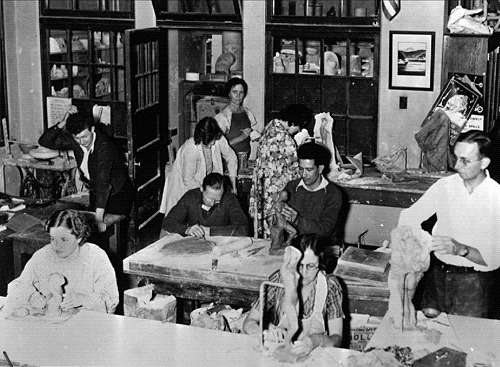
WPA Art Classes
(WPA poster, courtesy of the Library of Congress Prints and Photographs Division.)
(A WPA art class in California. The description for this photograph reads, "Clay arts are among the crafts which afford an outlet for adults whose days are buried in the routine of the modern industrial plant." Photo courtesy of the National Archives and the New Deal Network.)
(The description for this photo reads, "Sculpturing is lots of fun at the Hudson Guild, one of the 241 art centers in New York where the WPA Federal Art Project holds free classes." Photo courtesy of the National Archives and the New Deal Network.)
New Deal policymakers felt that art classes and art projects were a great way to get unemployed artists and teachers back to work, to teach children and adults new skills, and to decorate public places. Today's policymakers? Neh, not so much. For example, K-12 art programs have been cut, or entirely eliminated, all across the nation, in order to preserve tax cuts for the super-wealthy and also to devote additional resources towards mechanized standardized test-taking.
(See, for example, "Public schools slash arts education and turn to private funding," ThinkProgress, August 5, 2013, "D.C. parents fight arts budget cuts," Washington Examiner, March 30, 2013, and "Conservative Republicans pledge to eliminate cultural funding," Washington Post, January 20, 2011.)
Will American society really be better off if we keep reducing public support for the arts, social studies, and physical education, and instead place more and more emphasis on high-stakes standardized testing-taking? Well, apparently a lot of people think so - because that's exactly what's happening. But that choice has consequences, e.g., bland architecture, a citizenry ignorant of its history, and high levels of childhood obesity. But hey, as long as billionaires can keep adding billions to their personal fortunes, I guess everything is a-ok, right?
Friday, March 27, 2015
A pictorial history of the Rural Electrification Administration - and the resulting New Deal lesson
All images below are from the U.S. Department of Agriculture publication, "Rural Lines – USA: The Story of the Rural Electrification Administration’s First Twenty-five Years, 1935-1960."
Above: Before electric power, life in rural America could be hard. How many of us can imagine what it would be like to wash our clothes on a board? Unfortunately, many private power companies weren't interested in supplying electricity to rural Americans. Other were interested...if the government and the farmers were willing to pay through the nose for it. Other companies felt that American farmers didn't need electricity, so why bother? Is it any wonder that, in 1935, only 11% of American farms had electric power, while citizens in more urbanized areas had been enjoying it for many years?
Above: Where the private power companies hesitated, the New Deal moved ahead aggressively, beginning in 1935 with the creation of the Rural Electrification Administration.
Above: Since the private power companies decided that they weren't going to play ball, New Deal policymakers decided to engage rural Americans more directly (through "co-ops") with long-term loans set at reasonable interest rates (i.e., not the loan shark interest rates that we see today with credit card and payday lending companies). Even better, individuals would not be personally liable for loan defaults, so there would be no predatory debt collectors knocking on the farm house door if things went sour (the electric power materials that had been bought and constructed would be the collateral).
Above: And so the work got started.
Above: Between 1935 and 1943, some of the prime years of the New Deal, nearly 400,000 miles of power lines were put up.
Above: Back in those days, they did whatever it took to get the job done.
Above: Once a home was hooked up to electricity, people could enjoy many new things; and also many old things a lot better. This man is enjoying his radio.
Above: A farmer works on his electric motor. By 1960, the Rural Electrification Administration had helped the percentage of American farms with electric power rise from 11% to 97%. New Deal policymakers and rural Americans had worked together to electrify the nation.
Today, many people say "The New Deal didn't work! It was a mistake!" They say this because wealthy self-interested people like Glenn Beck, Sarah Palin, Rush Limbaugh, Rupert Murdoch, and the Koch brothers have convinced them that the government is always wrong (except when it bombs other countries, of course). But if Americans stopped listening to these people, and did real research, they would discover that almost everything they've been told are lies designed to excuse usury, cuts to education, stagnant wages, lack of adequate health care, crumbling infrastructure, extreme wealth inequality, record levels of child homelessness, rich Americans hiding money in foreign bank accounts, financial fraud, and our world-leading prison population.
The success of the Rural Electrification Administration is just one of the many stories about how a federal government that focuses on helping the middle-class & poor, instead of pampering the super-wealthy, can make incredible things happen. Other New Deal examples include the CCC's development of hundreds of state parks, the WPA's modernization of our infrastructure, Social Security's mitigation of old-age poverty, FDIC's protection of bank deposits, TVA's supply of massive amounts of power, PWA-built ships that helped us win World War II, and the list goes on and on.
And make no mistake about it, our collective ignorance of American history has real consequences. For example, Americans pay more for Internet service than other developed countries but receive less adequate service. Further, as if this were not bad enough, some corporate-bought governments have made it illegal for local communities to provide themselves with better Internet service.
And so this is what happens when voters pay more attention to self-interested millionaires & billionaires, and not to the history of good government policies like the New Deal and the Rural Electrification Administration.
The success of the Rural Electrification Administration is just one of the many stories about how a federal government that focuses on helping the middle-class & poor, instead of pampering the super-wealthy, can make incredible things happen. Other New Deal examples include the CCC's development of hundreds of state parks, the WPA's modernization of our infrastructure, Social Security's mitigation of old-age poverty, FDIC's protection of bank deposits, TVA's supply of massive amounts of power, PWA-built ships that helped us win World War II, and the list goes on and on.
And make no mistake about it, our collective ignorance of American history has real consequences. For example, Americans pay more for Internet service than other developed countries but receive less adequate service. Further, as if this were not bad enough, some corporate-bought governments have made it illegal for local communities to provide themselves with better Internet service.
And so this is what happens when voters pay more attention to self-interested millionaires & billionaires, and not to the history of good government policies like the New Deal and the Rural Electrification Administration.
Monday, March 23, 2015
A New Deal for California
(The Civilian Conservation Corps helped maintain, protect, and improve Lassen Volcanic National Park in northern California - see Living New Deal page here. WPA poster, courtesy of the Library of Congress Prints and Photographs Division.)
Civil Works Administration (CWA):
In January of 1934, there were 164,000 Californians working in the CWA, building or repairing schools, roads, bridges, and more.
(Source: "Analysis of Civil Works Program Statistics," 1939, p. 18)
Civilian Conservation Corps (CCC):
Between 1933 and 1942, 135,000 California men were employed in the CCC. This included about 120,000 junior and veteran enrollees, 2,400 Indians, and 12,900 staff. Among their many accomplishments were the planting of 31 million trees and the protection of 792,000 acres from tree and plant disease.
The CCC program in California also presented an opportunity "to carry out forest fire presupression plans, as well as plans for fighting forest fires." By the end of the program, the CCC boys had devoted about 980,000 man-days of work towards such efforts.
(Source: Perry H. Merrill, "Roosevelt's Forest Army: A History of the Civilian Conservation Corps, 1933-1942," 1981, pp. 112-113)
(CCC boys at Rock Creek, California, 1933. Before joining the CCC, many young men stowed away on trains looking for work in different parts of the country. What do you think is better for a young man? Unemployed and drifting, or the scene you see above? Photo courtesy of the FDR Presidential Library and Museum.)
(California CCC enrollees in boxing gear, 1933. Recreation and physical fitness were important components of the CCC program. In 2013, the National Institutes of Health informed us that "People in the U.S. are becoming obese at younger ages, and more than one-third of adults are obese" ("Young Adult Obesity May Affect Later Heart Disease"). Photo courtesy of the FDR Presidential Library and Museum.)
Federal Emergency Relief Administration (FERA):
In February of 1935, 8,700 college students in California were employed in FERA's College Student Aid Program. This was a program "undertaken in order to enable young persons who would not otherwise have been able to do so to continue their education, and thereby reduce the influx of young workers into the labor market" (recall that during the Great Depression there was a large drop in the demand for labor).
Between 1933 and 1935, FERA granted $164 million to California for relief efforts (about $2.7 billion in today's dollars). FERA funds typically went towards cash relief, rural relief projects, and a wide variety of work programs.
(Source: "Final Statistical Report of the Federal Emergency Relief Administration," 1942, pp. 64, 103, and 232)
By 1939, the PWA had contributed $103 million in funding towards 807 infrastructure projects in California (not including federal projects). In today's dollars, that's about $1.7 billion.
(Source: "America Builds: The Record of PWA," 1939, p. 285)
(A PWA-funded water tower in Fresno, California, ca. 1933-1943. Photo courtesy of the National Archives and the New Deal Network.)
National Youth Administration (NYA):
During academic year 1939-1940, 576 schools and colleges in California were participating in the NYA program, employing about 20,000 students each month.
During any given month of fiscal year 1942, there were about 6,700 young California men & women in the NYA's out-of-school work program.
One of the main objectives of the NYA program was to give work experience to young Americans who were having a hard time "getting in the door" for employment and also (during World War II) to prepare them for defense work. In 1943, the California Shipbuilding Corporation in Wilmington California, wrote: "...these men (NYA) have come to us well-qualified for shipyard work, and they have proven themselves to be excellent employees. We hope your training program is to continue during the coming year and that we shall be able to count on additional men..."
(Source: Federal Security Agency - War Manpower Commission, "Final Report of the National Youth Administration, Fiscal Years 1936-1943," 1944, pp. 162, 246-247, and 254)
(The description for this undated photo reads, "These National Youth Administration workers are digging clams at Morro Beach, CA. They will use the clams to restock tidal creeks where the bivalves have become scarce." Photo courtesy of the National Archives and the New Deal Network.)
Post Offices:
During the New Deal era, the U.S Treasury built or expanded Post Office buildings in California and commissioned artists to decorate them. See the Living New Deal for examples.
(This mural is in the Main Post Office of Berkeley, California. It is called "Incidents in California History," and was created by artist Suzanne Scheuer, 1936-1937. Photo by Gray Brechin.)
Between 1933 and 1934, in Regions 14 and 15 of the PWAP (California, Nevada, Utah), unemployed artists were paid to create 55 sculptures, 105 murals, 266 oil paintings, 435 water color paintings, and other works of art, for use in public buildings and parks.
The director of Region 14 of the PWAP (southern California) was Merle Armitage, "one of America's leading advocates of modern culture." The director of Region 15 (northern California, Nevada, Utah) was Walter Heil (see "Walter Heil Papers, 1929-1973" Smithsonian Archives of American Art).
(Source: Public Works of Art Project, "Report of the Assistant Secretary of the Treasury to Federal Emergency Relief Administrator, December 8, 1933 - June 30, 1934," 1934, pp. ii and 8)
Between 1935 and 1943, WPA workers in California produced 29 million articles of clothing; served 50 million school lunches; created or improved 11,000 miles of roads; built or improved 1,400 bridges; installed or improved 21,000 culverts; engaged in 1,200 projects to build, repair, or improve schools; created or improved 458 parks; installed 1,200 miles of new water lines; constructed 53 miles of new airport & airfield runway; and more.
(Source: "Final Report on the WPA Program, 1935-43," 1946, pp. 134-136)
(The CCC boys weren't the only ones planting trees. These WPA men are planting trees in California, ca. 1935-1938. Photo from "Inventory: An Appraisal of Results of the Works Progress Administration," 1938.)
(For parents who needed help, the WPA ran nursery schools - like this one in San Francisco. Photo courtesy of the National Archives and the New Deal Network.)
(A WPA voice training class in San Francisco, for women with hearing problems. Photo courtesy of the National Archives and the New Deal Network.)
Saturday, March 21, 2015
WPA Fruits & Vegetables
Above: WPA poster created in New York City, ca. 1936-1941. Image courtesy of the Library of Congress Prints and Photographs Division.
Above: The description for this 1938 photo reads, "WPA Hot School Lunch Project--School lunches are prepared and distributed by trucks for undernourished children to schools in the District of Columbia. Photo shows scene at a Municipal Market. Fruits and vegetables for this Hot School Lunch Project are obtained through markets, the same as any large restaurant or hotel. Photo courtesy of the National Archives and the New Deal Network.
Above: The description for this undated photo reads, "Three WPA gardening projects in Denver, Pueblo and Greeley will produce approximately 665 tons of vegetables for distribution to indigent families receiving direct relief. A million cans of vegetables grown and processed by WPA workers will be distributed in these three cities under the supervision of the State Department of Public Welfare and county government. Shot shows one of the gardens from which the vegetables are grown. Photo courtesy of the National Archives and the New Deal Network.
Subscribe to:
Posts (Atom)