Thursday, January 16, 2014

Women and the WPA (part 7 of 10): Preserving our history

Women played an important role in the WPA's historic preservation efforts. While men provided most of the muscle for the physical restoration of structures, women helped (and in many cases led) other types of preservation initiatives.

Above: The caption for this 1938 photo reads, "Mrs. Julia B. Davis, Supervisor of the Historical Records Survey Project of the WPA at the Frederick Douglass Memorial Home, Washington, D.C. is pictured at the right holding the walking stick once used by Abraham Lincoln. This relic was given to Frederick Douglass by Mrs. Lincoln upon the death of the emancipator, and is being recorded by Maurice Champ, as two other WPA workers on the project observe. There is one Supervisor and four other capable WPA employees on this Historical Records Survey project." Photo courtesy of the National Archives and New Deal Network.  

Above: The caption for this photo, taken in New York City, reads, "Supervisor and WPA workers are shown discussing the various colors of silk to be used in the restoration of the historic battle flag before them." Photo courtesy of the National Archives and the New Deal Network.

Above: "WPA workers indexing and preserving census records," in New York City, October 1936. Photo courtesy of the National Archives and New Deal Network. 

Above: WPA clerical workers in Hagerstown, Maryland, 1937, preparing for the 75th anniversary of the Battle of Antietam, to be held near Sharpsburg, Maryland. Photo courtesy of the University of Maryland College Park Archives.    

Above: Female WPA artist Vera Bock created this poster in 1936. Image courtesy of the Library of Congress Prints and Photographs Division.

There is always history to preserve, to record, to teach, etc. What a shame, during a period of high unemployment and low workforce participation, Congress fails to connect the dots that New Deal policy-makers connected long ago, offering unemployed women (and men) useful work opportunities in the fields of history and historic preservation. 

Wednesday, January 15, 2014

Women and the WPA (part 6 of 10): Nursery schools

The WPA operated nursery schools for many American children. If, for example, a single parent had a job, or the child's parents were in the military or war industries, the WPA was there to help. Women operating WPA nurseries helped the war effort, helped Americans in need, and helped care for the children of America's Greatest Generation. Out of the problem of unemployment came a great, effective idea.      

Above: A woman who works in the war industry brings her child to a WPA nursery in Pennsylvania before heading off to her job. Photo courtesy of the National Archives and New Deal Network.

Above: Children enjoying music at a WPA nursery school in Buffalo, New York. Photo courtesy of the National Archives and New Deal Network.

Above: A WPA teacher prepares children for mealtime, at a nursery school in Yakima, Washington, 1941. Photo courtesy of the Library of Congress Prints and Photographs Division. 

Above: The carefree days of youth, at a WPA nursery school in Arizona. Photo courtesy of the Library of Congress Prints and Photographs Division.

Above: Eleanor Roosevelt visits a WPA nursery in Des Moines, Iowa, in 1936. Note the WPA sign behind the woman on the right. Photo courtesy of the FDR Presidential Library and Museum. 

Above: Two children paint at a WPA nursery school in San Francisco, 1938. Photo courtesy of the FDR Presidential Library and Museum. 

Above: This undated photo is described as a National Youth Administration (NYA) nursery school in Baltimore City. The NYA started out as a subdivision of the WPA, offering work and training opportunities for teens and young adults. Photo courtesy of the University of Maryland College Park Archives.

Tuesday, January 14, 2014

Women and the WPA (part 5 of 10): Libraries, books, and reading

In a variety of ways, women in the WPA helped Americans read more during the Great Depression. From the tragedy of unemployment came a variety of win-win policies. Women were given jobs, books were repaired, libraries were staffed, children were taught, and more. Today, as multinational corporations, big financial institutions, and bought politicians move jobs out of America, and as the labor force participation rate drops to its lowest level since 1978, we would do well to remember an era of American history when unemployment was addressed in a compassionate, logical, and patriotic manner.

Above: This poster, "Story Hour," was created by WPA artist Shari Weisberg. It was one of many that the WPA created to promote reading. Image courtesy of the Library of Congress Prints and Photographs Division.

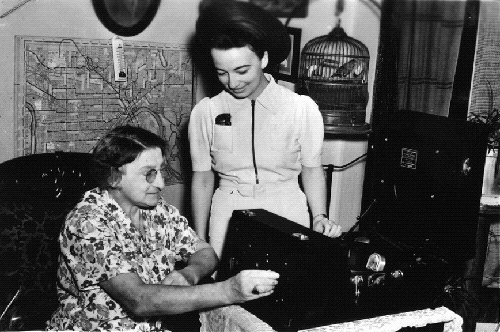
Above: The description for this photo, taken in St. Paul, Minnesota, reads: "WPA worker demonstrates a talking book to a blind woman." Image courtesy of the National Archives and New Deal Network. 

Above: Another story hour poster by WPA artist Shari Weisberg, showing a boy and a girl, on what appears to be a magic carpet, or rather, book ride. Image courtesy of the Library of Congress Prints and Photographs Division.

Above: One of the more interesting WPA projects was the employment of women as "pack horse librarians." Pack horse librarians delivered books and magazines to families living in remote, rural areas. The caption for this photo, taken in 1938, reads, "Carriers, mostly women, travel the remote sections of the state by horse and mule. They meet once a week at their library headquarters where saddle-bags are replenished with books for eager mountain folk. These carriers are paid a small salary by the WPA in Kentucky." Image courtesy of the National Archives and New Deal Network.  

Above: A pack horse librarian reads to a Kentucky man who is either injured or ill, and possibly illiterate. This type of service by the government (paying an unemployed woman to deliver and read books to rural Americans), while perfectly in line with the general welfare clause of the U.S. Constitution, would not be tolerated in America today. While plutocracy and special treatment for the super-wealthy has been accepted, and white collar crime tolerated, this type of service to Americans in need would inevitably be denounced as "godless communism!" Image courtesy of the National Archives and New Deal Network. 

Above: This woman is transcribing a book into Braille at the Enoch Pratt Library in Baltimore, Maryland, as part of a WPA project to help bring more books to blind Americans. Image courtesy of the University of Maryland College Park Archives.

  Above: These women are repairing books at the Enoch Pratt Library in Baltimore, Maryland, as part of WPA project no. 123, in 1936. The description card for this photo reads, "The second step in bookmending is sewing through with clamp and drill when center sections of books are broken--Drilling books and preparing cover for recasing." Across America, over 94 million books were repaired by WPA workers. Image courtesy of the University of Maryland College Park Archives.

Above: A man and two women looking at books at a WPA-operated bookmobile. Across the country, WPA workers--both men and women--assisted, or wholly operated, bookmobiles and libraries. Image courtesy of the FDR Presidential Library and Museum.

Above: This photo shows National Youth Administration (NYA) enrollees in Mississippi being trained as library workers. At the time of this photo, 1936, the NYA was a subdivision of the WPA. This type of work and training opportunity is a stark contrast from the inhuman political rhetoric that we hear today, which would label these women as "takers," and also from the days of slavery, just a few generations before this photo was taken, where blacks were often whipped if they were caught reading, or trying to learn how to read. The history of slavery (i.e., a highlight and warning as to what man is capable of), and the cold-hearted insults hurled at the less-fortunate today, are prime reasons why we need a new, and even stronger, New Deal. Image courtesy of the FDR Presidential Library and Museum.       

Monday, January 13, 2014

Women and the WPA (part 4 of 10): Sewing

During the Great Depression, unemployed women across the country could find work in WPA sewing rooms. These sewing rooms produced 382 million articles of clothing for men, women, and children. It was a win-win situation, with jobless women earning money and low-income Americans receiving much-needed clothes. Additionally, many women who worked in the WPA sewing rooms subsequently found jobs in private employment, utilizing the skills they had acquired while in the WPA. Unfortunately, jobless women have no such opportunities today--our plutocratic congressmen and women abandoned them years ago, more interested in campaign contributions from the well-to-do than in helping those in need. As op-ed writer Stephen Seufert writes with respect to unemployed construction workers, our uninspiring, bland policymakers in D.C. have a "void of vision and foresight." But it wasn't always so...

Above: The caption for this photo reads, "All products on the Milwaukee WPA Sewing Project are made from original designs drawn by project artists. Mary Jane Thomas is shown designing a new cotton house dress on this project. The Milwaukee WPA Sewing Project employs 900 women. It has industrial type of machines throughout and the work plan is comparable with that of private industry." Photo courtesy of the National Archives and the New Deal Network.

Above: To contribute to the war effort, women in WPA sewing room projects produced or repaired "clothes, including shoes, and tents, blankets, knapsacks, web belting, canteen covers...draperies..." (from the Final Report on the WPA Program, 1935-43). WPA poster image courtesy of the Library of Congress Prints and Photographs Division. 

Above: This WPA sewing room project was located at 4940 Eastern Avenue in Baltimore, Maryland, which is now the location of Johns Hopkins Bayview Medical Center. Photo courtesy of the National Archives and the New Deal Network.

Above: This WPA poster highlights occupations related to sewing. Image courtesy of the Library of Congress Prints and Photographs Division.
 
Above: Women in WPA sewing room projects also made toys and stuffed animals for disadvantaged children. These stuffed animals, and dresses, were made in a WPA sewing room project in Prince George's County, Maryland. Photo courtesy of the University of Maryland College Park Archives.

Above: WPA sewing room projects could employ a large number of jobless women, as this project in Denver, Colorado highlights. Photo courtesy of the National Archives and New Deal Network.

Sunday, January 12, 2014

Women and the WPA (part 3 of 10): Healthcare

Today, unemployed and low-income women are the victims of social exclusion. Like unemployed and low-income men, their jobless benefits are under constant threat of reduction or elimination, there are no public works jobs created for them, they are discriminated against by employers and, if they are childless, and reside in a Republican-managed state, they are likely not allowed to participate in the Medicaid expansion offered by the Affordable Care Act. But the ruthlessness of social exclusion, facilitated by our gruesome politics, is not the only alternative, as the following images from the New Deal era illustrate. 

Above: Unemployed nurses were hired into the WPA to provide healthcare services to low-income Americans. The caption for this photo (taken in Minneapolis) reads, "Operated by WPA funds, the Home provides special diet and proper rest to correct abnormal hearts of these children. 59 employed." Photo courtesy of the National Archives and the New Deal Network. 

Above: This WPA poster urges prompt healthcare treatment for women. Image courtesy of the Library of Congress Prints and Photographs Division.

Above: WPA nurses and nutrition workers made house calls, like this one in Louisiana. The woman on the right appears to be giving instruction on the proper mixing of baby formula. Photo courtesy of the FDR Presidential Library and Museum and the New Deal Network. 

Above: This poster was created by WPA artist Erik Hans Krause (1899-1990), and was one of several he made related to women's health and health generally. Image courtesy of the Library of Congress Prints and Photographs Division.

Above: Men and women in the WPA school lunch program served over 1.2 billion school lunches to children. The work was tedious, but vital to improving the health of children from low-income families. The caption for this photo reads, "WPA Hot School Lunch Project--School lunches are prepared and distributed by trucks for undernourished children to schools in the District of Columbia. Photo shows troup of women in the Central Kitchen preparing 5,200 sandwiches for the Hot School Lunches." Photo courtesy of the National Archives and the New Deal Network. 

Above: One of several WPA posters related to the health of mother and infant. Image courtesy of the Library of Congress Prints and Photographs Division.

What a shame that we don't have a WPA today, for unemployed and low-income women, and that we have, instead, embraced the mean-spirited art of social exclusion.

Saturday, January 11, 2014

Women and the WPA (part 2 of 10): Artists

The WPA offered many job opportunities for artistically-minded women: Painting, writing, sculpting, art instruction, performing arts, and more.   

Above: This WPA poster promotes an exhibition of art created by women. Image courtesy of the Library of Congress Prints and Photographs Division.
  
Above: In the late 1930s, WPA artist Lenore Thomas created this "Mother and Child" sculpture in Greenbelt, Maryland. Photo by Brent McKee.  

Above: Women performing in a WPA Theatre dance production. Photo courtesy of the FDR Presidential Library and Museum. 

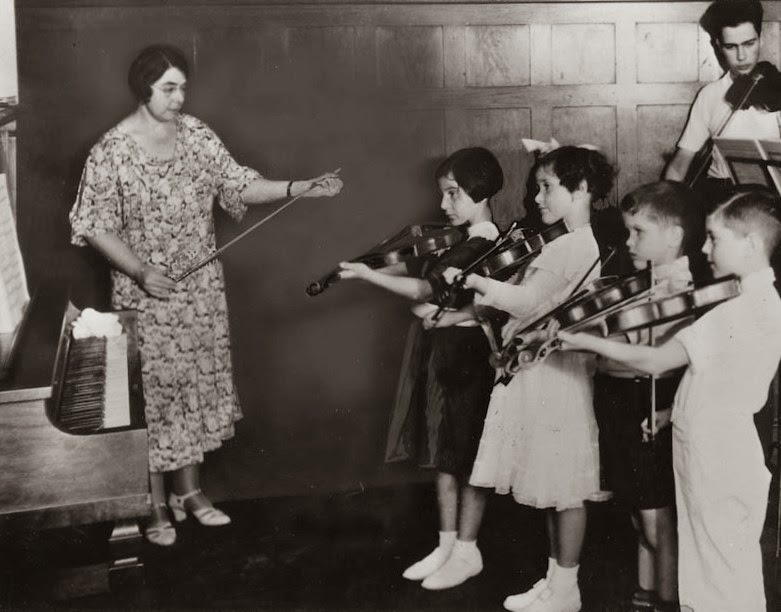
Above: A WPA music instructor giving violin lessons to girls and boys. Photo courtesy of the FDR Presidential Library and Museum.

Above: The caption for this photo reads, "The first lesson in clay modeling for a little boy at a Community Center operated by the WPA Recreation program in California." Image courtesy of the National Archives and the New Deal Network.

Above: Artist Lucienne Bloch working on a WPA mural project. Image courtesy of the National Archives and the New Deal Network.

Friday, January 10, 2014

Women and the WPA (part 1 of 10): Administration

Women could earn top administrative posts in the WPA (1935-1943), at the federal, regional, and state levels. Three of the most prominent female administrators were Hallie Flanagan, Mary McLeod Bethune, and Ellen Woodward.

Above: Hallie Flanagan was in charge of the national WPA Theatre program. Image courtesy of the Library of Congress Prints and Photographs Division. 
Above: Mary McLeod Bethune was a director in the National Youth Administration which, during its first four years of existence, was a subdivision of the WPA. Image courtesy of the Library of Congress Prints and Photographs Division.

Above: Ellen Woodward ran the WPA's Division of Women's and Professional Projects. Image courtesy of the Library of Congress Prints and Photographs Division.